

Bacteriostatic vs Sterile Water: What Changes in the Lab
Understand the preservative difference, why solvent labels matter, and what neither water type can tell you about a research peptide’s stability.
| Main distinction | Presence or absence of an antimicrobial preservative |
|---|---|
| Hero preservative | 0.9% benzyl alcohol |
| 0.9% expressed by mass | 9 mg/mL benzyl alcohol |
| Solvent compatibility | Specific to the material and assay |
| Shelf-life boundary | Diluent labeling does not validate the resulting peptide solution |
| Hero product | Bacteriostatic Water |
Bacteriostatic vs sterile water is a comparison of formulations, not a choice between clean and unclean water. Bacteriostatic water can also be sterile. The important difference is the added preservative and the way the specific product is labeled.
For peptide research, that difference affects what goes into the experimental solution. It does not establish that every peptide dissolves well, remains intact, or retains activity for a fixed number of days. Choose the vehicle from the material’s documentation and the assay requirements.
Origin story: why two water labels exist
Manufacturer labeling distinguishes water containing a bacteriostatic preservative from preservative-free Sterile Water for Injection. The bacteriostatic label reviewed here describes benzyl alcohol in a multiple-dose container. The sterile-water label describes a preparation with no antimicrobial agent or added buffer in single-dose containers (ProPharma Distribution, 2025; Hospira, 2026).
Those labels describe specific pharmaceutical products. They are useful sources for understanding the terms, but they do not establish that another supplier’s water has the same packaging, specifications, or approval status. Match any handling claim to the actual label on the actual product.
The bacteriostatic water guide covers the preserved vehicle individually. Here, the focus is what changes when a preservative enters a laboratory preparation and how to keep that change visible.
How bacteriostatic and sterile water differ
At a stated 0.9% weight-per-volume concentration, benzyl alcohol contributes 0.9 g per 100 mL, or 9 mg/mL. Preservative-free sterile water lacks that added ingredient. These are different vehicles even if both appear clear (ProPharma Distribution, 2025; Hospira, 2026).
A preservative is an experimental ingredient. When a sample is diluted into an assay, its vehicle is diluted too. Record the final vehicle concentration and use an appropriate vehicle control, so a response is not automatically attributed to the peptide alone.
The word sterile describes a microbial quality attribute, while bacteriostatic describes an effect on bacterial growth. Neither term measures the peptide’s chemical integrity. A solution can satisfy one criterion while failing another, so the terms should not be used as substitutes.
Also distinguish sterile water from ordinary distilled water, laboratory purified water, and buffered solutions. Their names describe different specifications or compositions. An experiment requiring one should not silently receive another because each looks like water.
Key evidence: what the labels and studies support
| Question | Bacteriostatic water | Preservative-free sterile water |
|---|---|---|
| Added antimicrobial preservative? | Yes, confirm the ingredient and concentration | No, for the product reviewed |
| Container designation in the reviewed label? | Multiple-dose | Single-dose |
| Automatically compatible with every peptide? | No | No |
| Establishes a peptide solution’s expiry? | No | No |
The manufacturer labels support the composition and container distinctions in the table. The bacteriostatic label also notes possible incompatibility with some solutes and directs users to the solute manufacturer’s instructions (ProPharma Distribution, 2025; Hospira, 2026).
Formulation research shows why the complete mixture matters. Pohl and colleagues investigated specifically engineered liquid glucagon formulations using selected excipients. Those experiments concern the tested formulations, rather than a universal rule that one water type stabilizes all peptides (Pohl et al., 2015).
A useful compatibility assessment asks whether the material stays dissolved, whether the expected analyte remains measurable, and whether the vehicle affects the assay signal. These are related questions, but a clear appearance answers only a small part of them.
Record the solvent as carefully as the compound. A note reading only water omits information another researcher needs. Include the product, lot, preservative concentration if present, and any further dilution into buffers or culture media.
Weak spots: what we don’t know
The familiar 28-day rule is often stretched beyond its scope. CDC describes a default handling interval for opened multiple-dose medication vials, unless the manufacturer specifies another date. It is not a study of the chemical stability of every peptide prepared with their contents (CDC, 2024).
CDC also explains that preservatives do not provide complete protection against bacterial contamination. Adding a preserved vehicle therefore does not sterilize a research powder or validate a contaminated preparation (CDC, 2024).
As of November 5, 2026, this comparison does not establish that Hero’s laboratory water is equivalent to either named pharmaceutical product. Pharmaceutical labels provide background on the terms; the supplied product’s documentation determines which specific claims can be made about it.
Handling research diluents in the lab
Start with documented compatibility, then calculate concentration. If a nominal 10 mg peptide sample is brought to a final solution volume of 2 mL, the concentration is 5 mg/mL, or 5,000 mcg/mL. A 0.10 mL analytical aliquot contains 500 mcg.
If the final stock vehicle contains 0.9% benzyl alcohol, a tenfold dilution gives 0.09%, assuming the second vehicle contains none and volumes are additive. The peptide concentration also falls tenfold. This simple check helps identify what the assay actually receives.
On a U-100 volume scale, 0.10 mL corresponds to 10 units. Those marks measure volume, not peptide potency. Use laboratory measuring equipment appropriate to the precision required, and distinguish final solution volume from the volume initially added.
Use the reconstitution guide and calculator to check the numbers. Keep the water container’s history separate from the resulting stock’s history. Their dates and storage requirements need not be the same.
Bacteriostatic vs sterile water FAQ
Is bacteriostatic water also sterile?
The labeled pharmaceutical preparation reviewed here is sterile and contains a preservative. The terms describe different attributes (ProPharma Distribution, 2025).
Does benzyl alcohol guarantee a 28-day peptide shelf life?
No. A medication-vial handling rule does not establish the chemical stability or activity of a particular research solution.
Which vehicle should an assay use?
Use one supported by the material documentation and assay design, with controls that account for its ingredients.
What is Hero Bacteriostatic Water?
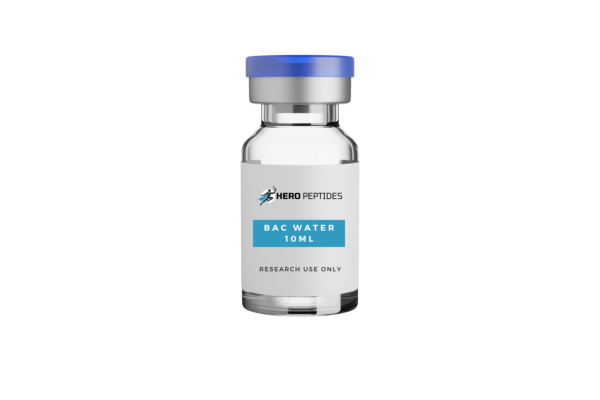
Hero Bacteriostatic Water is the catalog’s 10 mL laboratory diluent containing 0.9% benzyl alcohol. Review its supplied documentation for product-specific specifications and handling conditions.
References
- ProPharma Distribution. Bacteriostatic Water for Injection, USP, prescribing information. Revised November 2025. DailyMed. Source.
- Hospira, Inc. Sterile Water for Injection, USP, prescribing information. Revised May 2026. DailyMed. Source.
- Centers for Disease Control and Prevention. Preventing Unsafe Injection Practices. 2024. Accessed November 5, 2026. Source.
- Pohl R, et al. Development of Stable Liquid Glucagon Formulations for Use in Artificial Pancreas. J Diabetes Sci Technol. 2015;9(1):8-16. Source.
For laboratory research use only. Not for human or veterinary use. This article summarizes published research and is not medical advice.