

Retatrutide (Hero RT): The Triple Agonist Research Guide
One molecule, three receptors. Here is what retatrutide is, how it works, and what the TRIUMPH phase 3 trials found.
| Also known as | LY3437943 |
|---|---|
| Class | GIP / GLP-1 / glucagon receptor triple agonist |
| Developer | Eli Lilly and Company |
| Structure | Single peptide chain with a C20 fatty diacid for albumin binding |
| Half-life (human studies) | About 6 days |
| Status (Nov 2026) | Investigational. FDA filing planned for Q1 2027 |
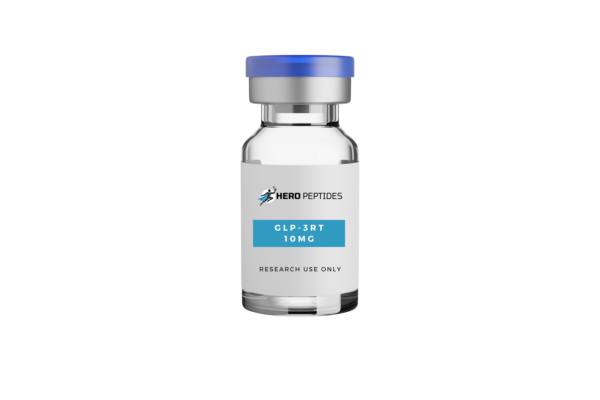
| Hero product | Hero RT |
Most metabolic peptides pick one target and commit. GLP-1 analogs like semaglutide work one receptor. Tirzepatide doubled up with GIP. Retatrutide went for the full set: it activates the GIP, GLP-1 and glucagon receptors with one molecule. That’s why it’s called a triple agonist, and why it has become one of the most studied compounds in metabolic research.
This guide covers where retatrutide came from, how it’s built, how each of its three “powers” works, and what the published phase 2 and phase 3 data actually say. Everything here is about research. Retatrutide is an investigational compound and isn’t approved for any use.
Origin story: where retatrutide came from
Retatrutide was developed by Eli Lilly under the code name LY3437943. The discovery paper, published in Cell Metabolism in 2022, describes a deliberate design goal: keep the appetite and insulin effects of GLP-1 and GIP, then add glucagon receptor activity to push energy expenditure and liver fat metabolism further (Coskun et al., 2022).
That last part sounds backwards at first. Glucagon raises blood glucose, so why add it to a metabolic compound? Because glucagon also increases energy expenditure and fat oxidation in the liver. Paired with GLP-1 and GIP, which lower glucose and drive insulin release, the glucose-raising effect is offset while the energy-burning effect stays. Read our GLP-1 vs GIP vs glucagon explainer for the receptor-by-receptor version.
How retatrutide is built
Retatrutide is a single peptide chain built on a GIP-like backbone, with amino acid substitutions that let it bind all three receptors. Like tirzepatide and semaglutide, it carries a fatty diacid side chain (C20) that binds albumin in the blood. That albumin “piggyback” protects it from breakdown and clearance, which is why human studies report a half-life of roughly six days, long enough for once-weekly dosing in clinical trials (Urva et al., 2022).
Its receptor balance is intentionally uneven. In the discovery work, retatrutide was more potent than native GIP at the human GIP receptor, and less potent than native GLP-1 and glucagon at their receptors (Coskun et al., 2022). In other words, GIP is turned up, while GLP-1 and glucagon are dialed in rather than maxed out. That tuning is what researchers mean when they talk about an “imbalanced” agonist.
Retatrutide’s three powers, one receptor at a time
GLP-1 receptor: the appetite and insulin lever
GLP-1 receptor activation increases glucose-dependent insulin secretion, suppresses glucagon release after meals, slows gastric emptying, and acts on appetite centers in the brain. It’s the mechanism behind every GLP-1 class compound and the foundation retatrutide builds on (Drucker, 2018).
GIP receptor: the amplifier
GIP is the other incretin hormone. Its receptor is found in the pancreas, fat tissue and the brain. GIP receptor agonism appears to add to GLP-1’s effects on insulin and appetite and may improve how well GLP-1 activity is tolerated. Retatrutide leans on this receptor hardest of the three.
Glucagon receptor: the energy dial
The glucagon receptor is mainly found in the liver. Activating it increases hepatic fat oxidation and overall energy expenditure. This is the piece that separates retatrutide from tirzepatide, and the reason researchers are especially interested in its effects on liver fat.
| Receptor | Main tissue | What activation does | Semaglutide | Tirzepatide | Retatrutide |
|---|---|---|---|---|---|
| GLP-1R | Pancreas, gut, brain | Insulin release, satiety, slower gastric emptying | ✓ | ✓ | ✓ |
| GIPR | Pancreas, fat tissue, brain | Insulin release, fat tissue signaling | – | ✓ | ✓ |
| GCGR | Liver | Energy expenditure, liver fat oxidation | – | – | ✓ |
What the phase 2 trials found
Two phase 2 trials put retatrutide on the map in 2023.
- Obesity (no diabetes): In a 48-week trial of 338 adults published in the New England Journal of Medicine, the highest dose group showed a mean body weight reduction of 24.2%, compared with 2.1% on placebo (Jastreboff et al., 2023).
- Type 2 diabetes: A phase 2 trial in The Lancet reported dose-dependent reductions in HbA1c and body weight versus placebo and versus dulaglutide (Rosenstock et al., 2023).
Those numbers were larger than anything previously reported for a single agent at that stage, which is why the phase 3 program drew so much attention.
The TRIUMPH phase 3 program: results so far
Lilly’s phase 3 program for retatrutide is called TRIUMPH. As of November 2026, all four of its main trials have reported topline results:
| Trial | Population | Length | Top-dose result | Reported |
|---|---|---|---|---|
| TRIUMPH-4 | Obesity with knee osteoarthritis | 68 weeks | −28.7% body weight | Dec 2025 |
| TRIUMPH-1 | Obesity or overweight, no diabetes (2,339 adults) | 80 weeks | −28.3% body weight (placebo −2.2%) | May 2026; NEJM Sep 2026 |
| TRIUMPH-2 | Type 2 diabetes with obesity or overweight | 80 weeks | −20.8% body weight, plus HbA1c reduction | Jul 2026; Lancet Sep 2026 |
| TRIUMPH-3 | Severe obesity with cardiovascular disease | 80 weeks | −22.6% body weight | Jul 2026 |
In TRIUMPH-1, Lilly reported that all three doses met the primary endpoints, and that 45.3% of participants on the highest dose reached at least 30% weight loss (Eli Lilly, May 2026). In TRIUMPH-3, the top dose also reduced triglycerides, non-HDL cholesterol, systolic blood pressure and hsCRP, a marker of inflammation (Eli Lilly, July 2026).
Two caveats matter when reading these numbers. First, topline figures from press releases often use a “treatment-regimen” or “efficacy” estimand, and the peer-reviewed papers can report different numbers depending on how dropouts are counted. Second, cross-trial comparisons with tirzepatide or semaglutide are only rough, because the populations and trial lengths differ. A direct comparison with tirzepatide, TRIUMPH-5, is expected to finish around the end of 2026.
Weak spots: what the safety data show
Every hero has a weakness. For retatrutide, the reported side effects look like the rest of the GLP-1 class, and they scale with dose:
- Gastrointestinal effects such as nausea, diarrhea, vomiting and constipation were the most common, mostly during dose escalation.
- Heart rate increases were seen in phase 2, peaking partway through treatment and then declining (Jastreboff et al., 2023).
- Discontinuation due to side effects in TRIUMPH-3 was 9.8% and 13.5% on the two doses, versus 4.8% on placebo (Eli Lilly, July 2026).
Long-term safety data are still being collected, and the compound remains investigational.
Where retatrutide research goes next
- Head-to-head data: TRIUMPH-5 will compare retatrutide directly with tirzepatide.
- Liver fat and MASLD: Glucagon receptor activity makes retatrutide a natural candidate for liver research.
- Regulatory filing: Lilly has said it plans to submit to the FDA in Q1 2027 (Eli Lilly, July 2026).
- Combination research: Amylin analogs such as cagrilintide (Hero CG) are being explored alongside incretin agonists.
Handling retatrutide in the lab
Hero RT ships as a lyophilized (freeze-dried) powder. To reconstitute it, follow our step-by-step peptide reconstitution guide, then use the peptide calculator to work out concentration and syringe units for your vial size. Store unopened vials cold and away from light, and keep reconstituted vials refrigerated.
Retatrutide FAQ
Is retatrutide the same as tirzepatide?
No. Tirzepatide activates two receptors (GIP and GLP-1). Retatrutide activates those two plus the glucagon receptor.
Is retatrutide FDA approved?
Not as of November 2026. Lilly has said it plans to file in the first quarter of 2027.
Why does a weight-related compound activate glucagon?
Glucagon receptor activation increases energy expenditure and liver fat burning. Combining it with GLP-1 and GIP is meant to keep those effects while balancing out glucagon’s glucose-raising effect.
What is Hero RT?
Hero RT is Hero Peptides’ research-grade retatrutide, supplied as a lyophilized powder for laboratory research use only.
References
- Coskun T, et al. LY3437943, a novel triple glucagon, GIP, and GLP-1 receptor agonist for glycemic control and weight loss: From discovery to clinical proof of concept. Cell Metab. 2022;34(9):1234-1247.
- Urva S, et al. LY3437943, a novel triple GIP, GLP-1, and glucagon receptor agonist in people with type 2 diabetes: a phase 1b, multicentre, double-blind, placebo-controlled, randomised, multiple-ascending dose trial. Lancet. 2022;400(10366):1869-1881.
- Jastreboff AM, et al. Triple-hormone-receptor agonist retatrutide for obesity: a phase 2 trial. N Engl J Med. 2023;389(6):514-526.
- Rosenstock J, et al. Retatrutide, a GIP, GLP-1 and glucagon receptor agonist, for people with type 2 diabetes: a randomised, double-blind, placebo and active-controlled, parallel-group, phase 2 trial conducted in the USA. Lancet. 2023;402(10401):529-544.
- Drucker DJ. Mechanisms of action and therapeutic application of glucagon-like peptide-1. Cell Metab. 2018;27(4):740-756.
- Eli Lilly and Company. Lilly’s triple agonist, retatrutide, delivered powerful weight loss in pivotal Phase 3 obesity trial. Press release, May 21, 2026.
- Eli Lilly and Company. Lilly’s triple agonist, retatrutide, successful in two additional Phase 3 obesity trials, delivering significant improvements in weight and A1C. Press release, July 23, 2026.
For laboratory research use only. Not for human or veterinary use. This article summarizes published research and is not medical advice.