
Bacteriostatic Water: What It Is and How It Works
The sidekick every peptide vial needs. What bacteriostatic water is, how benzyl alcohol works, and how long an opened vial lasts.
| What it is | Sterile water with 0.9% benzyl alcohol |
|---|---|
| Preservative action | Bacteriostatic: stops bacteria multiplying, does not sterilize |
| Typical pH | 4.5–7.0 |
| Common use window after opening | Up to 28 days |
| Not for | Neonatal use, or peptides incompatible with benzyl alcohol |
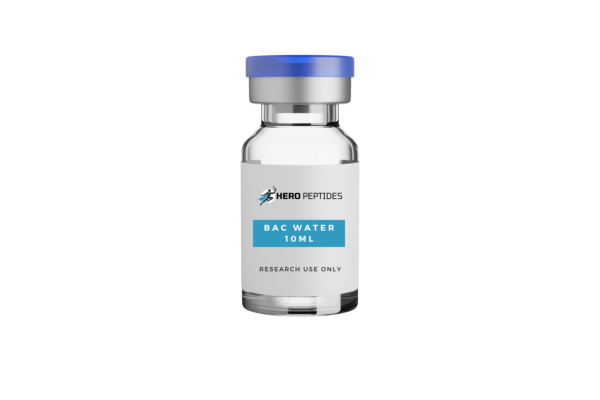
| Hero product | BAC Water |
Every peptide in our lineup needs a sidekick before it can be measured, and for most research peptides that sidekick is bacteriostatic water. It looks like plain water, but a small amount of benzyl alcohol makes it suitable for vials that get punctured again and again.
This guide covers what’s in it, how the preservative works, when to use something else, and how long it lasts.
Origin story: why preservatives exist
Every time a needle goes through a rubber stopper, there’s a small chance of bringing in bacteria. In a single-use vial that doesn’t matter. In a multi-use vial it does. Preservatives like benzyl alcohol were added to injectable water and multi-dose drugs to keep bacteria from growing between uses (Meyer et al., 2007).
How it works
Benzyl alcohol at 0.9% disrupts bacterial cell membranes enough to stop bacteria from multiplying. That’s what bacteriostatic means: it stops growth, but it doesn’t kill everything already present. It’s a backup, not a substitute for clean technique.
Bacteriostatic vs sterile water
| Bacteriostatic water | Sterile water | |
|---|---|---|
| Contents | Water + 0.9% benzyl alcohol | Water only |
| Multi-use vials | Yes | No |
| Use window after opening | Commonly up to 28 days | Use immediately |
| Best for | Most research peptides | Single-use, or preservative-sensitive peptides |
The 28-day window comes from guidance on multi-dose vials (USP <797>). Always follow the label on your vial.
When not to use it
- Preservative-sensitive peptides. A few peptides are less stable with benzyl alcohol, or less soluble in it. Check product documentation.
- Neonatal applications. Benzyl alcohol was linked to “gasping syndrome” in premature infants in the early 1980s, and it’s not used in neonatal products (CDC, 1982).
- Poorly soluble peptides. Some need dilute acetic acid or another solvent. See our reconstitution guide.
Storage and shelf life
- Unopened: room temperature, away from light, until the expiry date.
- Opened: commonly used for up to 28 days. Swab the stopper before every entry and use a new sterile needle each time.
- Discard if cloudy, discolored or past its window.
Weak spots: common mistakes
- Treating it as sterilizing. It isn’t.
- Using tap water, distilled water or saline as a substitute.
- Reusing needles between vials.
Bacteriostatic water FAQ
How much bacteriostatic water do I add to a peptide?
Enough to give an easy-to-measure concentration, often 1–3 mL for 5–20 mg vials. Use the peptide calculator.
Does bacteriostatic water expire?
Yes. Unopened vials have an expiry date. Opened vials are commonly used within 28 days.
What is Hero BAC Water?
10 mL vials of sterile water with 0.9% benzyl alcohol, for laboratory reconstitution of research peptides.
References
- United States Pharmacopeia. Bacteriostatic Water for Injection monograph.
- United States Pharmacopeia. General Chapter <797> Pharmaceutical Compounding: Sterile Preparations.
- Centers for Disease Control and Prevention. Neonatal deaths associated with use of benzyl alcohol, United States. MMWR. 1982;31(22):290-291.
- Meyer BK, Ni A, Hu B, Shi L. Antimicrobial preservative use in parenteral products: past and present. J Pharm Sci. 2007;96(12):3155-3167.
For laboratory research use only. Not for human or veterinary use. This article summarizes published research and is not medical advice.