

CJC-1295 (No DAC): The Modified GRF 1-29 Research Guide
Two compounds share one name. What CJC-1295 without DAC really is, how GHRH analogs work, and how it compares with the DAC version.
| Also known as | Modified GRF (1-29), tetrasubstituted GRF 1-29 |
|---|---|
| Class | GHRH receptor agonist |
| Length | 29 amino acids |
| Substitutions | D-Ala2, Gln8, Ala15, Leu27 |
| Half-life | Around 30 minutes (vs a few minutes for native GHRH 1-29) |
| Hero product | CJC-1295 (no DAC) |
CJC-1295 has a naming problem. The original CJC-1295 carries a DAC (Drug Affinity Complex) that binds albumin and lasts about a week. The version most labs call “CJC-1295 without DAC” is a different molecule, more accurately called Modified GRF (1-29). This guide explains the difference, how GHRH analogs work, and what’s been published.
Origin story: shortening GHRH
Growth hormone releasing hormone (GHRH) is a 44-amino-acid hypothalamic hormone. Its first 29 amino acids carry the full activity, and that fragment, GHRH(1-29), became the compound sermorelin. Native GHRH(1-29) is broken down within minutes by DPP-4 and other enzymes. Four amino acid swaps make Modified GRF (1-29) more resistant to that breakdown.
How it’s built
- D-Ala at position 2: blocks DPP-4 cleavage, the same trick used in GLP-1 analogs (see semaglutide).
- Gln8, Ala15, Leu27: reduce chemical breakdown and improve receptor binding.
With DAC vs without DAC
| CJC-1295 with DAC | Mod GRF 1-29 (no DAC) | |
|---|---|---|
| Albumin binding | Yes, via maleimide-lysine linker | No |
| Half-life | 5.8–8.1 days (Teichman et al., 2006) | Around 30 minutes |
| GH pattern | Raised baseline, pulses preserved | Short pulse |
| Hero product | Not stocked | CJC-1295 |
In healthy adults, a single dose of CJC-1295 with DAC raised GH levels 2–10 fold for six days or more, and IGF-1 levels 1.5–3 fold for 9–11 days (Teichman et al., 2006). GH still came in pulses during that time (Ionescu and Frohman, 2006).
How GHRH analogs work
GHRH analogs activate the GHRH receptor on pituitary somatotroph cells, which raises cAMP and triggers GH release. Ghrelin receptor agonists like ipamorelin act through a separate receptor, so the two classes are often studied together.
Weak spots: what we don’t know
- Little no-DAC data. Most published human data are for the DAC version, which was developed by ConjuChem and discontinued in clinical development.
- Not approved. Neither form is approved, and WADA prohibits GHRH analogs.
Handling CJC-1295 in the lab
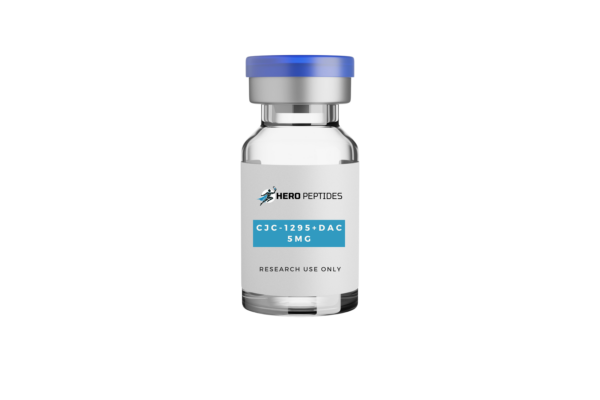
Hero CJC-1295 ships lyophilized in 5 mg vials. With 2 mL of bacteriostatic water you get 2.5 mg/mL, so 100 mcg is 4 units. Follow the reconstitution guide and check the math with the calculator.
CJC-1295 FAQ
Is CJC-1295 without DAC the same as Mod GRF 1-29?
Yes. “CJC-1295 no DAC” is the common research name for Modified GRF (1-29).
What does DAC stand for?
Drug Affinity Complex, a linker that binds albumin and extends the half-life to about a week.
What is Hero CJC-1295?
Hero Peptides’ research-grade Mod GRF (1-29), supplied lyophilized for laboratory research use only.
References
- Teichman SL, et al. Prolonged stimulation of growth hormone (GH) and insulin-like growth factor I secretion by CJC-1295, a long-acting analog of GH-releasing hormone, in healthy adults. J Clin Endocrinol Metab. 2006;91(3):799-805.
- Ionescu M, Frohman LA. Pulsatile secretion of growth hormone (GH) persists during continuous stimulation by CJC-1295, a long-acting GH-releasing hormone analog. J Clin Endocrinol Metab. 2006;91(12):4792-4797.
- Jetté L, et al. hGRF1-29-albumin bioconjugates activate the GRF receptor on the anterior pituitary in rats: identification of CJC-1295 as a long-lasting GRF analog. Endocrinology. 2005;146(7):3052-3058.
For laboratory research use only. Not for human or veterinary use. This article summarizes published research and is not medical advice.