
Ipamorelin: The Selective GH Secretagogue Research Guide
The first selective growth hormone secretagogue. What ipamorelin is, how it targets the ghrelin receptor, and what the studies found.
| Class | Growth hormone secretagogue (ghrelin receptor agonist) |
|---|---|
| Length | 5 amino acids |
| Sequence | Aib-His-D-2Nal-D-Phe-Lys-NH2 |
| Developer | Novo Nordisk (1990s) |
| Half-life (human studies) | About 2 hours |
| Known for | GH release without meaningful ACTH or cortisol rise |
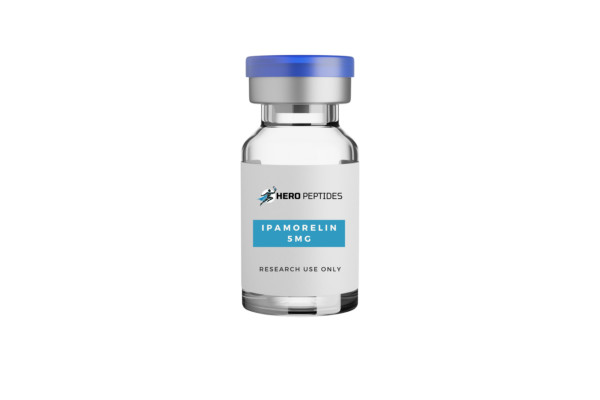
| Hero product | Ipamorelin |
Early growth hormone secretagogues had a side quest problem. Compounds like GHRP-6 and GHRP-2 raised growth hormone, but they also raised cortisol, ACTH and prolactin. Ipamorelin was the first compound in the class to release growth hormone selectively, which is why its discovery paper called it “the first selective growth hormone secretagogue” (Raun et al., 1998).
This guide covers how ipamorelin is built, how the ghrelin receptor works, and what the published studies report.
Origin story: cleaning up the GHRP class
Growth hormone releasing peptides (GHRPs) were developed in the 1980s and 90s, before anyone knew which receptor they hit. Novo Nordisk designed ipamorelin as a smaller, cleaner pentapeptide. In animal studies it raised GH as effectively as GHRP-6, but did not raise ACTH or cortisol even at doses far above those needed for GH release (Raun et al., 1998).
The receptor itself was identified later. In 1999, researchers discovered ghrelin, a hunger hormone from the stomach, as its natural ligand (Kojima et al., 1999).
How ipamorelin works
Ipamorelin activates the growth hormone secretagogue receptor (GHS-R1a), the ghrelin receptor, on cells in the pituitary and hypothalamus. That triggers a pulse of GH release. It works alongside GHRH, which acts on a separate receptor. See our CJC-1295 guide for the GHRH side.
| Ipamorelin | GHRP-6 | GHRP-2 | |
|---|---|---|---|
| Length | 5 aa | 6 aa | 6 aa |
| GH release | Yes | Yes | Yes |
| Cortisol / ACTH rise | Not meaningful | Yes | Yes |
| Hunger signaling | Mild | Strong | Moderate |
Key studies
- Selectivity: in swine, ipamorelin released GH without raising ACTH or cortisol (Raun et al., 1998).
- Human pharmacokinetics: in healthy volunteers, ipamorelin produced a single GH peak, with a half-life of about two hours (Gobburu et al., 1999).
- Gut motility: because ghrelin also speeds gut movement, ipamorelin was tested for postoperative ileus. A phase 2 trial did not meet its primary endpoint (Beck et al., 2014).
Weak spots: what we don’t know
- Limited human data. Clinical development stopped after the ileus trials.
- Not approved. Ipamorelin is not approved for any use, and WADA lists GH secretagogues as prohibited.
Handling ipamorelin in the lab
Hero Ipamorelin ships lyophilized in 10 mg vials. With 2 mL of bacteriostatic water you get 5 mg/mL, so 100 mcg is 2 units on a U-100 syringe. If you want larger, easier-to-read volumes, add 4 mL instead (2.5 mg/mL, so 100 mcg is 4 units). See the reconstitution guide and the calculator.
Ipamorelin FAQ
Is ipamorelin a GHRP?
Yes. It’s a pentapeptide member of the GHRP class, and it’s more selective than GHRP-2 or GHRP-6.
Why is ipamorelin often paired with CJC-1295?
They act on different receptors (ghrelin vs GHRH), so researchers study them together to look at combined effects on GH pulses.
What is Hero Ipamorelin?
Hero Peptides’ research-grade ipamorelin, supplied lyophilized for laboratory research use only.
References
- Raun K, et al. Ipamorelin, the first selective growth hormone secretagogue. Eur J Endocrinol. 1998;139(5):552-561.
- Kojima M, et al. Ghrelin is a growth-hormone-releasing acylated peptide from stomach. Nature. 1999;402(6762):656-660.
- Gobburu JV, et al. Pharmacokinetic-pharmacodynamic modeling of ipamorelin, a growth hormone releasing peptide, in human volunteers. Pharm Res. 1999;16(9):1412-1416.
- Beck DE, et al. Prospective, randomized, controlled, proof-of-concept study of the ghrelin mimetic ipamorelin for the management of postoperative ileus in bowel resection patients. Int J Colorectal Dis. 2014;29(12):1527-1534.
For laboratory research use only. Not for human or veterinary use. This article summarizes published research and is not medical advice.