

How to Read a Peptide Certificate of Analysis
Read a peptide COA by separating identity, chromatographic purity, content, and traceability, with a worked example showing why those measurements differ.
| COA meaning | Certificate of analysis |
|---|---|
| First check | Sample and lot match the supplied material |
| HPLC purity | A method-dependent chromatographic result |
| Mass spectrometry | Evidence about molecular identity |
| Content or assay | A separate question about amount |
| Missing result | Not established by an unrelated test |
| Hero product | BPC-157 |
A peptide certificate of analysis is useful because it connects a named sample to reported measurements. The large purity percentage may attract attention first, but it is only one part of the document. Identity, amount, methods, and sample traceability deserve their own checks.
Reading a COA well means asking what each result establishes and what remains unmeasured. This guide follows the report from sample identification to concentration math, using a hypothetical example rather than inventing a result for an actual Hero lot.
Origin story: why one percentage cannot describe a vial
Peptide reference-standard programs use multiple analytical approaches because quality has several dimensions. McCarthy and colleagues describe complementary methods for identity, purity, and value assignment in characterized peptide standards. Those distinct measurements explain why a single headline percentage is incomplete (McCarthy et al., 2023).
A COA compresses laboratory work into a short report. That makes it convenient, but it also removes context unless the report identifies methods, units, and sample details. Read it as a summary of defined tests, not a universal certificate of suitability.
Start with the sample name and lot identifier. Match them with the container and purchase record. Then look for a report number, testing laboratory, sample receipt or test dates, and a way to verify the document with the issuing laboratory.
How a peptide COA works
Separate specifications from results. A specification is a criterion the sample is being judged against; a result is what the test reported. A line reading purity at least 98% is not the same as a measured result of 99.2%.
Next, read the units and the basis of measurement. Percentage peak area, percentage mass fraction, milligrams per vial, and an observed mass-to-charge ratio are different quantities. They should not be exchanged simply because each is printed beside a compound name.
NIST’s peptide reference-material report illustrates this distinction by defining peptide mass purity relative to the mass of lyophilized material and reporting molecular-mass information separately. It is an analytical example, not a certificate for a Hero product (NIST, 2007).
Check the sample scope too. A result from the submitted sample supports conclusions about that sample under the stated method. Claims about every container in a lot need appropriate sampling and lot controls beyond the visual presence of one certificate.
Key evidence: what each COA line can tell you
| Report item | Question it addresses | Follow-up question |
|---|---|---|
| Sample and lot | Which material was submitted? | Does it match this vial? |
| HPLC purity | How was detected chromatographic material distributed? | Which method, detector, and integration rules? |
| Mass spectrometry | Is observed mass information consistent with the expected material? | Was only intact mass measured, or additional structure? |
| Content or assay | How much peptide was assigned or measured? | What units, reference, and uncertainty apply? |
| Other quality tests | Was a specific additional attribute assessed? | Is an actual result reported? |
For HPLC, ask whether the reported purity is based on relative peak areas. Such a result depends on what the method separates and detects. It does not automatically measure the percentage of all powder mass that is peptide or the amount in a vial.
For mass spectrometry, identify whether the report shows observed ions, a deconvoluted mass, or sequence-related analysis. McCarthy and colleagues describe why complementary techniques may be needed, including for chiral or isobaric amino-acid features that mass alone may not resolve (McCarthy et al., 2023).
For content, look for a quantitative measurement with a clear basis. Højrup describes amino acid analysis as a way to characterize peptide composition and quantity, with method-specific limitations. A chromatographic purity result does not replace that separate quantitative question (Højrup, 2015).
For additional attributes such as water, residual solvents, endotoxin, or sterility, find the actual test and result. If absent, write not reported. Passing one chemical test does not supply a missing microbiological result.
Weak spots: what we don’t know
A COA is a snapshot of reported testing. It does not establish that a later prepared solution remains unchanged, nor does it replace the storage history. The storage guide explains the records needed after receipt and preparation.
Document authenticity and analytical scope are also separate checks. A genuine laboratory report may contain a limited test panel. Verifying the issuer does not expand that panel, while a detailed-looking page is not proof that the issuer produced it.
As of November 5, 2026, BPC-157 remains unapproved as a human medicine in the United States, with limited safety information identified by FDA. In April 2026, FDA moved BPC-157 from its category 2 compounding list to its list of nominations withdrawn by the nominators, though that page still records the agency’s safety concerns. That change is not a drug approval. A COA does not establish clinical approval or human safety, regardless of the purity percentage shown (FDA, 2026).
Hero names Northfield Analytical as its testing partner, with HPLC and mass-spectrometry testing listed for each lot. Request the report matching the material you receive. Read the reported methods and results rather than assuming the testing partnership establishes every possible quality attribute.
Handling COA numbers in the lab
Consider a hypothetical vial labeled 5 mg with an HPLC area-purity result of 99%. Multiplying 5 mg by 0.99 does not establish 4.95 mg of peptide in the vial. The label amount and the area percentage do not, by themselves, measure the same quantity.
If a separate, appropriate quantitative assay instead establishes 4.80 mg of peptide per vial, and that material is quantitatively recovered at a final volume of 2 mL, the calculated concentration is 2.40 mg/mL. That equals 2,400 mcg/mL, giving 240 mcg in a 0.10 mL analytical aliquot.
Without the measured-content result, the 5 mg label would support only a nominal calculation of 2.5 mg/mL at that volume. Keep nominal and measured values distinct. Record the source of each number instead of silently changing its meaning.
The reconstitution guide and calculator can verify arithmetic. They cannot decide whether a COA’s test establishes content. That decision comes from the method and reporting basis.
Peptide certificate of analysis FAQ
Does 99% HPLC purity mean 99% of the vial’s powder mass?
Not automatically. Read whether the result is an area percentage or a separately established mass-based measurement.
Does an expected mass prove every structural detail?
No. Some structural distinctions require complementary methods beyond intact mass (McCarthy et al., 2023).
Does a COA establish the prepared solution’s shelf life?
No. A lot-testing report and a stability study of a specific prepared solution answer different questions.
What is Hero BPC-157?
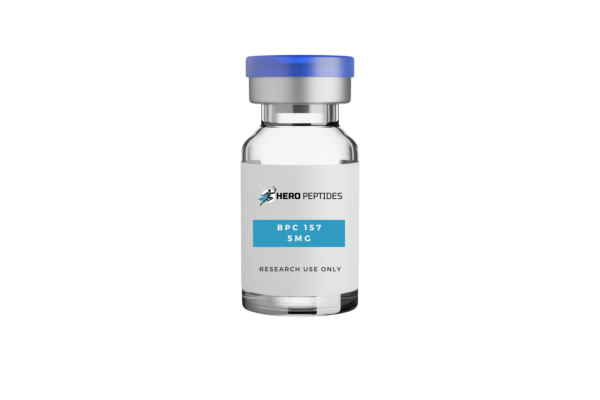
Hero BPC-157 is the catalog’s BPC-157 research material, supplied in 5 mg and 10 mg vials. Evaluate the matching lot report for the measurements your experiment requires.
References
- McCarthy D, et al. Reference Standards to Support Quality of Synthetic Peptide Therapeutics. Pharm Res. 2023;40(6):1317-1328. Source.
- National Institute of Standards and Technology. Reference Material 8327: Peptide Reference Material for Molecular Mass and Purity Measurements. Archived report of investigation, March 19, 2007. Source.
- Højrup P. Analysis of Peptides and Conjugates by Amino Acid Analysis. Methods Mol Biol. 2015;1348:65-76. Source.
- U.S. Food and Drug Administration. Certain Bulk Drug Substances for Use in Compounding that May Present Significant Safety Risks. Content current as of April 22, 2026. Accessed November 5, 2026. Source.
For laboratory research use only. Not for human or veterinary use. This article summarizes published research and is not medical advice.