

BPC-157: The Gastric Pentadecapeptide Research Guide
Fifteen amino acids, hundreds of animal studies, very few human ones. What BPC-157 is and what the research actually shows.
| Full name | Body Protection Compound-157 |
|---|---|
| Class | Synthetic pentadecapeptide (15 amino acids) |
| Sequence | Gly-Glu-Pro-Pro-Pro-Gly-Lys-Pro-Ala-Asp-Asp-Ala-Gly-Leu-Val |
| Molecular weight | About 1,419 Da |
| Origin | Partial sequence of a protein found in human gastric juice |
| Evidence base | Mostly rodent and cell studies. Very limited human data |
| Hero product | BPC-157 |
Most of the peptides in this blog come from big pharma programs with thousands of trial participants behind them. BPC-157 has a different background. It comes from a small, long-running research group in Zagreb, and almost everything known about it comes from animal and cell studies. That’s a lot of data, but it’s a different kind of evidence, and it’s worth understanding both what it shows and where it stops.
This guide covers where BPC-157 came from, how it’s built, the mechanisms researchers have proposed, and the gaps in the evidence.
Origin story: a fragment from gastric juice
BPC stands for Body Protection Compound, a protein the Zagreb group isolated from human gastric juice. BPC-157 is a 15-amino-acid stretch of that protein, made synthetically. It was first described in the early 1990s, and since then the same group has published a large body of work on it across gut, tendon, muscle, bone, blood vessel and nervous system models (Sikiric et al., 2016; Seiwerth et al., 2018).
One unusual property drew early interest: BPC-157 is reported to be stable in gastric juice for hours. Most peptides are broken down quickly in the stomach, which is why researchers have studied it both by injection and by mouth in animal models.
How BPC-157 is built
- Length: 15 amino acids (a pentadecapeptide).
- Sequence: GEPPPGKPADDAGLV. The run of three prolines near the start is thought to contribute to its stability.
- No modifications: unlike semaglutide or tirzepatide, it carries no fatty acid chain or unnatural amino acids.
- Salt forms: research material is commonly supplied as an acetate salt. Some suppliers also offer an arginate salt, marketed for better stability in solution.
Proposed mechanisms
BPC-157 doesn’t have a single, well-defined receptor the way GLP-1 analogs do. Instead, studies point to several pathways it appears to influence:
| Pathway | What studies report | Model |
|---|---|---|
| Angiogenesis (VEGFR2) | Increased VEGFR2 expression and activation, with more new blood vessel formation | Endothelial cells, rat hind limb (Hsieh et al., 2017) |
| Cell migration (FAK–paxillin) | Faster tendon fibroblast outgrowth and migration | Rat tendon fibroblasts (Chang et al., 2011) |
| Nitric oxide system | Interacts with NO signaling, with effects on blood vessel tone and blood flow | Rodent models (Sikiric et al., 2016) |
| Growth hormone receptor | More GH receptor expression in tendon fibroblasts | Rat tendon fibroblasts (Chang et al., 2014) |
The common thread is tissue repair signaling: blood vessel growth, cell migration and survival. That’s why BPC-157 is so often studied alongside TB-500, which works through a different repair pathway. See our BT-20 blend explainer for the pairing.
What the animal research covers
- Gastrointestinal models: ulcers, fistulas, inflammatory bowel models and intestinal anastomosis healing.
- Musculoskeletal models: tendon, ligament, muscle and bone injury in rats (reviewed by Gwyer et al., 2019).
- Vascular models: blood vessel occlusion and collateral circulation.
- Nervous system models: nerve injury and brain–gut axis studies.
A 2019 review of the musculoskeletal work concluded that the rodent results were consistently positive, but noted that nearly all of them came from one research group and that human trials were missing (Gwyer et al., 2019). That remains the central caveat.
Weak spots: what we don’t know
- Human data are minimal. Published human data are limited to small case series. There are no completed, peer-reviewed randomized controlled trials.
- Single-group concentration. Most studies come from one lab. Independent replication would strengthen the evidence base.
- Angiogenesis cuts both ways. Promoting blood vessel growth is useful in repair models, but it’s also a reason for caution in long-term safety research.
- Regulatory status. In 2023 the FDA placed BPC-157 in Category 2 of its bulk drug substances list for compounding, citing insufficient safety data. In April 2026 it moved BPC-157 to its list of withdrawn nominations. As of November 2026, BPC-157 is still not an approved drug. WADA lists it as a prohibited substance. Check current status before planning any work.
Handling BPC-157 in the lab
BPC-157 ships as a lyophilized powder. It dissolves readily in bacteriostatic water. Follow our reconstitution guide and use the peptide calculator for concentrations. For example, 10 mg in 2 mL gives 5 mg/mL, so 250 mcg is 5 units on a U-100 syringe. Keep reconstituted vials refrigerated and away from light.
BPC-157 FAQ
What does BPC stand for?
Body Protection Compound, a protein isolated from human gastric juice. BPC-157 is a 15-amino-acid fragment of it.
Is BPC-157 FDA approved?
No. It’s not approved for any use. The FDA placed it in Category 2 for compounding in 2023, then moved it to its withdrawn-nominations list in April 2026. That change is not an approval.
What’s the difference between BPC-157 and TB-500?
BPC-157 is a gastric-derived peptide studied mainly for blood vessel and cell migration signaling. TB-500 is a fragment of thymosin beta-4, which works through actin. Read our TB-500 guide.
What is Hero BPC-157?
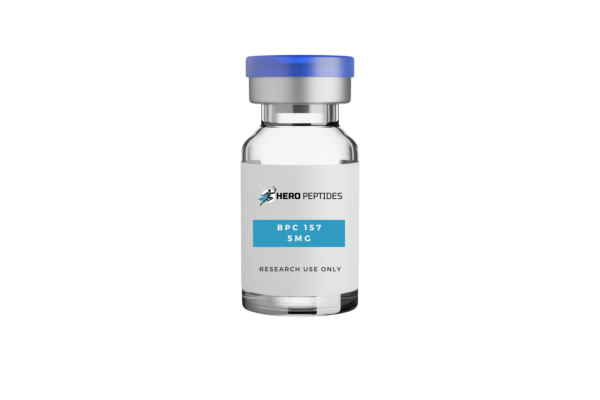
Hero Peptides’ research-grade BPC-157, supplied as a lyophilized powder in 5 mg and 10 mg vials for laboratory research use only.
References
- Sikiric P, et al. Brain-gut axis and pentadecapeptide BPC 157: theoretical and practical implications. Curr Neuropharmacol. 2016;14(8):857-865.
- Seiwerth S, et al. BPC 157 and standard angiogenic growth factors. Gastrointestinal tract healing, lessons from tendon, ligament, muscle and bone healing. Curr Pharm Des. 2018;24(18):1972-1989.
- Chang CH, et al. The promoting effect of pentadecapeptide BPC 157 on tendon healing involves tendon outgrowth, cell survival, and cell migration. J Appl Physiol. 2011;110(3):774-780.
- Chang CH, et al. Pentadecapeptide BPC 157 enhances the growth hormone receptor expression in tendon fibroblasts. Molecules. 2014;19(11):19066-19077.
- Hsieh MJ, et al. Therapeutic potential of pro-angiogenic BPC157 is associated with VEGFR2 activation and up-regulation. J Mol Med. 2017;95(3):323-333.
- Gwyer D, Wragg NM, Wilson SL. Gastric pentadecapeptide body protection compound BPC 157 and its role in accelerating musculoskeletal soft tissue healing. Cell Tissue Res. 2019;377(2):153-159.
For laboratory research use only. Not for human or veterinary use. This article summarizes published research and is not medical advice.