

TB-500: The Thymosin Beta-4 Fragment Research Guide
A fragment of one of the most abundant proteins in your cells. What TB-500 is, how thymosin beta-4 works, and what the studies found.
| Parent protein | Thymosin beta-4 (Tβ4), 43 amino acids |
|---|---|
| Active region | LKKTETQ (residues 17–23), the actin-binding motif |
| Main job of Tβ4 | Binds G-actin and controls actin polymerization |
| Found in | Nearly all cells, especially platelets and white blood cells |
| Evidence base | Cell and animal studies, plus clinical trials of full-length Tβ4 |
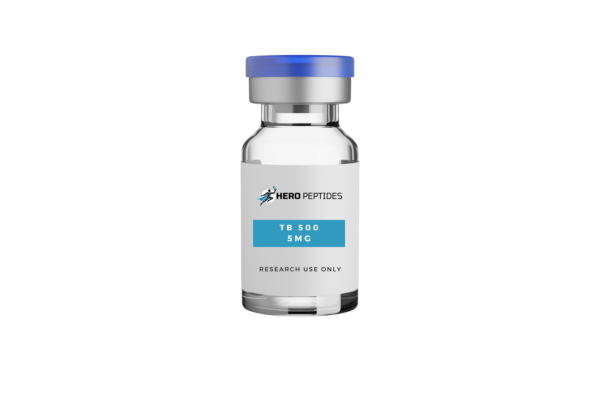
| Hero product | TB-500 |
Thymosin beta-4 is one of the most abundant small proteins inside your cells. Its day job is mundane but essential: it holds onto actin, the protein cells use to build their internal skeleton and to move. Researchers later found that it also seems to help with tissue repair. TB-500 is the synthetic research version, built around the part of thymosin beta-4 that does the actin work.
This guide covers what TB-500 is (and why the name is confusing), how thymosin beta-4 works, and what the published research reports.
Origin story: from the thymus to every cell
Thymosin beta-4 (Tβ4) was first isolated from thymus tissue, which is where the “thymosin” name comes from. It turned out not to be a thymus hormone at all. Tβ4 is found in almost every cell type and is especially concentrated in platelets and white blood cells, which release it at injury sites (Goldstein et al., 2005).
What “TB-500” actually means
TB-500 is a research name, not a scientific one, and different suppliers use it for different molecules:
- Full-length Tβ4: the complete 43-amino-acid protein, acetylated at the N-terminus.
- Fragment: a short synthetic peptide containing the LKKTETQ sequence (residues 17–23), the region responsible for actin binding and much of Tβ4’s reported repair activity.
Hero TB-500 is a Tβ4 fragment. Always check the certificate of analysis to confirm which molecule you have, because the molecular weights are very different.
How thymosin beta-4 works
Actin sequestering
Cells keep a pool of free actin units (G-actin) ready to build filaments (F-actin) when they need to change shape or move. Tβ4 binds G-actin and holds it in reserve, which helps control how fast filaments grow. That’s central to cell migration, one of the first steps in wound repair.
Repair signaling
Beyond actin, studies report that Tβ4 promotes cell migration, new blood vessel formation and cell survival, and reduces inflammation in injury models (Goldstein et al., 2005). In heart cells it activates integrin-linked kinase (ILK), a survival and migration signal (Bock-Marquette et al., 2004).
Key studies
| Study | Model | Finding |
|---|---|---|
| Malinda et al., 1999 | Rat skin wounds | Tβ4 increased re-epithelialization and wound contraction |
| Bock-Marquette et al., 2004 | Mouse heart injury | Tβ4 improved cardiac cell survival and heart function after injury |
| Smart et al., 2007 | Adult mouse heart | Tβ4 mobilized epicardial progenitor cells and promoted new blood vessels |
Full-length Tβ4 has also been tested in human clinical trials, mainly as eye drops for corneal conditions and as topical formulations for wounds. Those trials used the full protein, not TB-500 fragments, so the results don’t transfer directly.
TB-500 vs BPC-157
| TB-500 | BPC-157 | |
|---|---|---|
| Source | Thymosin beta-4 (in nearly all cells) | Gastric juice protein |
| Main proposed mechanism | Actin binding, cell migration | VEGFR2, FAK–paxillin, nitric oxide |
| Size | Fragment (short) or full 43 aa | 15 aa |
| Hero product | TB-500 | BPC-157 |
Because the two act through different pathways, they’re often studied together. See our BT-20 blend and GLOW blend explainers, and the BPC-157 guide.
Weak spots: what we don’t know
- Fragment vs full protein. Most published data use full-length Tβ4. Fragment-specific research is much thinner.
- Human data. There are no published human trials of TB-500 fragments.
- Regulatory status. TB-500 is not approved for any use, and WADA lists thymosin beta-4 and its derivatives as prohibited.
Handling TB-500 in the lab
Hero TB-500 ships lyophilized in 10 mg vials. Reconstitute with bacteriostatic water using our reconstitution guide. For example, 10 mg in 2 mL gives 5 mg/mL. Use the peptide calculator for syringe units, and keep the solution refrigerated.
TB-500 FAQ
Is TB-500 the same as thymosin beta-4?
Not always. The name is used for both full-length Tβ4 and shorter synthetic fragments. Hero TB-500 is a fragment.
What does thymosin beta-4 do?
It binds actin and controls how cells build their internal skeleton, which is key to cell migration. Studies also link it to blood vessel growth and repair signaling.
What is Hero TB-500?
Hero Peptides’ research-grade thymosin beta-4 fragment, supplied as a lyophilized powder for laboratory research use only.
References
- Goldstein AL, Hannappel E, Kleinman HK. Thymosin β4: actin-sequestering protein moonlights to repair injured tissues. Trends Mol Med. 2005;11(9):421-429.
- Malinda KM, et al. Thymosin β4 accelerates wound healing. J Invest Dermatol. 1999;113(3):364-368.
- Bock-Marquette I, et al. Thymosin β4 activates integrin-linked kinase and promotes cardiac cell migration, survival and cardiac repair. Nature. 2004;432(7016):466-472.
- Smart N, et al. Thymosin β4 induces adult epicardial progenitor mobilization and neovascularization. Nature. 2007;445(7124):177-182.
For laboratory research use only. Not for human or veterinary use. This article summarizes published research and is not medical advice.