

GLOW Blend: BPC-157, TB-500 and GHK-Cu Explained
Three research peptides in one vial. What is in GLOW, why these three, and how to work out the concentration of each.
| Contents | BPC-157 10 mg + TB-500 10 mg + GHK-Cu 50 mg |
|---|---|
| Total peptide | 70 mg per vial |
| Ratio | 1 : 1 : 5 |
| Research on the blend itself | None published. Evidence is per component |
| Appearance | Blue (from GHK-Cu) |
| Hero product | GLOW |
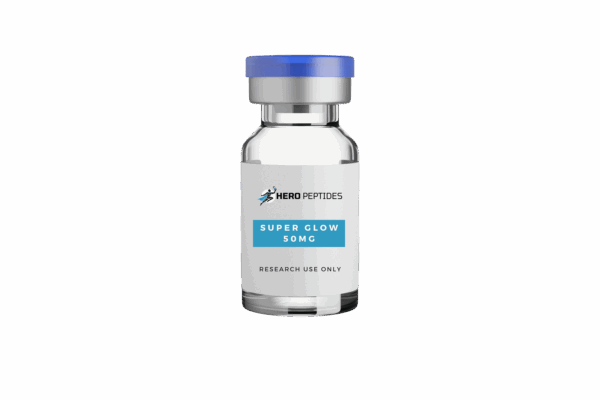
GLOW is a team-up vial. It combines three research peptides that are often studied for different parts of tissue repair: BPC-157, TB-500 and GHK-Cu. Instead of reconstituting three vials, researchers reconstitute one.
One thing up front: there is no published research on this specific blend. Everything known comes from studies of each component on its own. This guide explains what each one brings and how to do the math.
Origin story: why these three?
Each component is studied for a different repair pathway, which is the logic behind combining them:
| Component | Amount | Main proposed pathway |
|---|---|---|
| BPC-157 | 10 mg | Blood vessel growth (VEGFR2), cell migration (FAK–paxillin) |
| TB-500 | 10 mg | Actin binding and cell migration |
| GHK-Cu | 50 mg | Copper delivery, collagen and matrix remodeling |
See the individual guides for the evidence behind each pathway.
How the ratio works
The blend is 1 : 1 : 5 by weight. Whatever volume you measure, you always get five parts GHK-Cu for every one part BPC-157 and one part TB-500. You can’t change the ratio once it’s mixed, which is the main trade-off of any blend.
Reconstitution math
Work out each component separately: divide its mg by the mL of water added.
| Water added | BPC-157 | TB-500 | GHK-Cu | 10 units (0.1 mL) contains |
|---|---|---|---|---|
| 2 mL | 5 mg/mL | 5 mg/mL | 25 mg/mL | 500 mcg + 500 mcg + 2.5 mg |
| 3 mL | 3.33 mg/mL | 3.33 mg/mL | 16.7 mg/mL | 333 mcg + 333 mcg + 1.67 mg |
| 5 mL | 2 mg/mL | 2 mg/mL | 10 mg/mL | 200 mcg + 200 mcg + 1 mg |
Use the peptide calculator with the BPC-157 amount (10 mg) to set units, then the other two follow the ratio. See the reconstitution guide for technique.
Weak spots: what we don’t know
- No blend studies. Interactions between the three in one solution haven’t been studied.
- Fixed ratio. Studies that need to vary one component should use single vials.
- Stability. Copper can interact with other peptides in solution. Keep the vial refrigerated and use it within its documented window.
GLOW FAQ
Why is GLOW blue?
GHK-Cu is a copper complex, and copper(II) gives the solution a blue color.
What’s the difference between GLOW and BT-20?
BT-20 contains BPC-157 and TB-500 only. GLOW adds 50 mg of GHK-Cu. See the BT-20 guide.
What is Hero GLOW?
A 70 mg lyophilized research blend of BPC-157, TB-500 and GHK-Cu, for laboratory research use only.
References
- Seiwerth S, et al. BPC 157 and standard angiogenic growth factors. Curr Pharm Des. 2018;24(18):1972-1989.
- Goldstein AL, Hannappel E, Kleinman HK. Thymosin β4: actin-sequestering protein moonlights to repair injured tissues. Trends Mol Med. 2005;11(9):421-429.
- Pickart L, Margolina A. Regenerative and protective actions of the GHK-Cu peptide in the light of the new gene data. Int J Mol Sci. 2018;19(7):1987.
For laboratory research use only. Not for human or veterinary use. This article summarizes published research and is not medical advice.