
GHK-Cu: The Copper Peptide Research Guide
Three amino acids and one copper ion. What GHK-Cu is, why it turns solutions blue, and what the collagen and gene expression research shows.
| Full name | Glycyl-L-histidyl-L-lysine copper(II) complex |
|---|---|
| Class | Copper-binding tripeptide |
| Discovered | 1973, in human plasma (Pickart and Thaler) |
| Plasma levels | Around 200 ng/mL at age 20, around 80 ng/mL by age 60 |
| Appearance | Blue to violet powder and solution |
| Evidence base | Cell, animal and topical cosmetic studies |
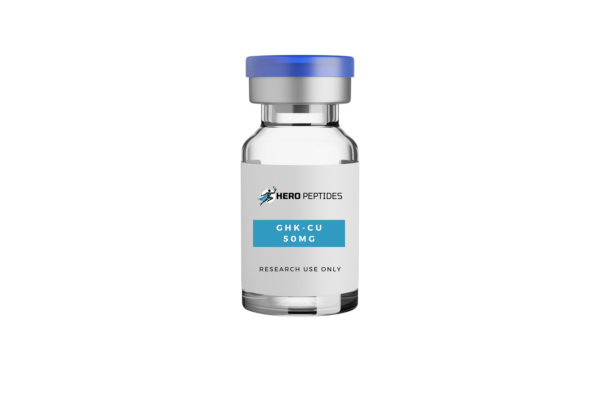
| Hero product | GHK-Cu |
GHK-Cu might be the smallest hero in the lineup: just three amino acids holding a single copper ion. It occurs naturally in human blood, saliva and urine, and it’s one of the few research peptides with a long track record in topical skin research. It’s also easy to spot. Open a vial and the powder is blue.
This guide covers where GHK-Cu came from, how copper binding works, and what the collagen, wound and gene expression studies report.
Origin story: a factor in young plasma
In 1973, Loren Pickart and colleagues noticed that liver tissue from older people behaved more like young tissue when it was incubated in plasma from younger donors. They traced part of the effect to a small tripeptide, glycyl-histidyl-lysine, or GHK (Pickart and Thaler, 1973). GHK binds copper(II) very tightly, and the copper complex, GHK-Cu, turned out to be the active form in many later studies.
GHK levels in plasma fall with age, from roughly 200 ng/mL at age 20 to about 80 ng/mL by age 60 (Pickart and Margolina, 2018). That decline is one reason it became a popular subject of aging and skin research.
How GHK-Cu is built
- Sequence: Gly-His-Lys.
- Copper binding: the copper ion is held by nitrogen atoms from glycine, the histidine ring and the peptide backbone, forming a stable complex.
- Color: the copper complex absorbs orange-red light, which is why it looks blue.
- Size: about 340 Da for GHK alone, roughly 400 Da with copper. Small enough to be studied in topical formulations.
Proposed mechanisms
Copper delivery
Copper is a cofactor for enzymes involved in tissue structure and antioxidant defense, including lysyl oxidase (which cross-links collagen and elastin) and superoxide dismutase. GHK can carry copper in a non-toxic form and deliver it to cells.
Matrix remodeling
In fibroblast cultures, GHK-Cu increased collagen synthesis (Maquart et al., 1988). Later studies reported effects on elastin, glycosaminoglycans and the enzymes that break down and rebuild the extracellular matrix.
Gene expression
Analyses of gene expression databases suggest GHK influences a large number of human genes, shifting many toward patterns associated with tissue repair and away from patterns linked to inflammation and tissue breakdown (Pickart et al., 2015). These are computational and cell-based findings, so they point to research directions rather than proven effects.
What the research covers
| Area | Type of evidence | Reported finding |
|---|---|---|
| Collagen synthesis | Fibroblast cell cultures | Increased collagen production |
| Wound models | Animal studies | Faster wound contraction and new blood vessel formation |
| Skin appearance | Small topical cosmetic studies | Improvements in skin density and fine lines vs control creams |
| Hair follicles | Cell and animal studies | Effects on follicle size and growth phase |
| Gene expression | Database analyses | Broad shifts in repair and inflammation genes |
Sources: Pickart et al., 2015; Pickart and Margolina, 2018.
Weak spots: what we don’t know
- Topical vs systemic. Most human data come from small cosmetic studies of creams and serums. Systemic research in humans is very limited.
- Copper balance. Copper is essential but toxic in excess. Concentration matters in any study design.
- Study size. Many studies are small and some are industry-funded.
GHK-Cu in blends
GHK-Cu is the largest component of our GLOW blend, alongside BPC-157 and TB-500. Read that guide for the ratio math.
Handling GHK-Cu in the lab
Hero GHK-Cu comes lyophilized in 50 mg and 100 mg vials, so concentrations run much higher than for other peptides. For example, 50 mg in 2.5 mL gives 20 mg/mL. Reconstitute using our reconstitution guide, check the math with the peptide calculator, and store the solution refrigerated and away from light. A clear blue solution is normal. A green tint or cloudiness is not.
GHK-Cu FAQ
Why is GHK-Cu blue?
The copper(II) ion bound to the peptide absorbs orange-red light, so the powder and solution look blue to violet.
What’s the difference between GHK and GHK-Cu?
GHK is the tripeptide on its own. GHK-Cu is the same peptide bound to copper, which is the form used in most studies.
What is Hero GHK-Cu?
Hero Peptides’ research-grade copper tripeptide, supplied as a lyophilized powder for laboratory research use only.
References
- Pickart L, Thaler MM. Tripeptide in human serum which prolongs survival of normal liver cells and stimulates growth in neoplastic liver. Nat New Biol. 1973;243(124):85-87.
- Maquart FX, et al. Stimulation of collagen synthesis in fibroblast cultures by the tripeptide-copper complex glycyl-L-histidyl-L-lysine-Cu2+. FEBS Lett. 1988;238(2):343-346.
- Pickart L, Vasquez-Soltero JM, Margolina A. GHK peptide as a natural modulator of multiple cellular pathways in skin regeneration. Biomed Res Int. 2015;2015:648108.
- Pickart L, Margolina A. Regenerative and protective actions of the GHK-Cu peptide in the light of the new gene data. Int J Mol Sci. 2018;19(7):1987.
For laboratory research use only. Not for human or veterinary use. This article summarizes published research and is not medical advice.