

CJC-1295 DAC vs No DAC: Why the Modification Matters
Learn why CJC-1295 research must distinguish the albumin-binding DAC construct from no-DAC material before interpreting half-life and growth-hormone findings.
| Shared research area | GHRH receptor signaling |
|---|---|
| DAC meaning | Drug affinity complex |
| Key structural issue | Presence or absence of albumin-reactive modification |
| Human half-life evidence | Long-acting DAC construct, not automatically no DAC |
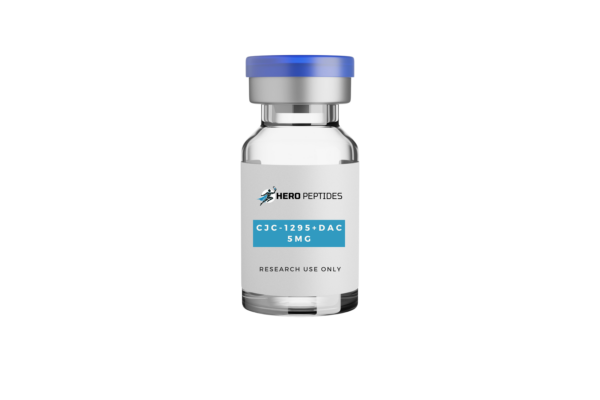
| Hero catalog form | CJC-1295, no DAC, 5 mg |
| Hero product | CJC-1295 (no DAC) |
CJC-1295 DAC vs no DAC looks like a small labeling difference. It is a major evidence boundary. A chemical modification intended to change albumin binding can change exposure, so findings from one construct should not be copied onto the other.
This comparison explains what DAC does, which material appears in the best-known human study, and why precise naming matters in laboratory records. It also separates concentration arithmetic from claims about how long a peptide remains active in a biological system.
Origin story: making GHRH-related signaling last longer
Early CJC-1295 work investigated an engineered growth hormone-releasing factor analog linked to albumin through a reactive group. The discovery study examined receptor activity and albumin-associated material in rats. Extending exposure was a central part of that research (Jetté et al., 2005).
The later human paper described CJC-1295 as a long-acting GHRH analog. Its findings are widely repeated, sometimes without the structural context needed to interpret them. The study concerns the albumin-binding construct, rather than any product that happens to share part of the name (Teichman et al., 2006).
That makes terminology part of the science. A useful comparison keeps the construct, salt form, and supporting analytical record visible from procurement through the final report. The CJC-1295 no-DAC research guide covers the catalog form in more detail.
How CJC-1295 DAC and no DAC are built
DAC stands for drug affinity complex. In the original program, the modification allowed the peptide to associate covalently with albumin through its reactive chemistry. The discovery work connected this approach to prolonged exposure and retained receptor activity in the tested models (Jetté et al., 2005).
No-DAC terminology indicates the absence of that modification. It does not establish a complete chemical identity by itself. The sequence, terminal chemistry, counterion, and measured content still matter when comparing a catalog entry with a publication or a reference standard.
FDA’s CJC-1295 briefing document treats the forms separately and warns against extrapolating the DAC pharmacological profile to material without that modification. This is a stronger basis for comparison than assuming that a shortened name implies identical behavior (FDA, 2024).
A useful materials sheet therefore gives each construct a separate entry. Record identifiers, expected mass, lot number, and documentation in the same place. This reduces the chance that a half-life or result is assigned to the wrong material during later analysis.
Key studies: which construct was actually tested?
| Evidence | System | Finding or role | Limit |
|---|---|---|---|
| Jetté et al., 2005 | Receptor and rat experiments | Albumin-bioconjugation strategy for long-acting CJC-1295 | Does not establish every no-DAC construct’s behavior |
| Teichman et al., 2006 | Healthy adults | Prolonged GH and IGF-I responses with long-acting CJC-1295 | Construct-specific clinical pharmacology |
| FDA briefing, 2024 | Regulatory evidence review | Separates CJC-1295-related substances and evidence gaps | Review document, not a direct efficacy trial |
The human study estimated a half-life of 5.8 to 8.1 days for the long-acting material. That figure belongs to the construct studied. It should not appear as a settled half-life for a no-DAC vial simply because both labels contain CJC-1295 (Teichman et al., 2006).
The practical question is not just whether a result exists. It is whether the result answers the question being asked about the material on the bench. A correct number attached to the wrong molecule can still produce an incorrect conclusion.
Exposure measurements also differ from downstream hormone measurements. A compound’s measured persistence, a growth hormone response, and an IGF-I response are related observations, but they are not interchangeable clocks. Keep the measured variable attached to each time interval.
For comparing studies, use separate columns for material, model, sampling period, and endpoint. A blank cell is preferable to importing an estimate from another construct. That makes an evidence gap visible rather than hiding it behind a precise-looking number.
Weak spots: what we don’t know
Short pharmacology studies do not establish long-term outcomes, and evidence from one construct does not validate every related material. Avoid treating a measured hormone change as proof of a broader functional benefit without a study that actually measured that benefit.
As of November 5, 2026, CJC-1295 is not an FDA-approved human medicine. In April 2026, FDA moved it from its category 2 compounding list to its list of withdrawn nominations, which is not an approval. FDA’s evidence review identifies major gaps, and its safety information notes limited clinical data and serious adverse events associated with CJC-1295 (FDA, 2024; FDA, 2026).
A research comparison should also avoid a simple safer-versus-stronger label. Such a label would need defined outcomes, comparable exposure, and data sufficient to support the ranking. The presence or absence of DAC alone does not supply that evidence.
Handling CJC-1295 in the lab
Label the construct explicitly before preparing a solution. Keep DAC and no-DAC records separate, even when an inventory system groups them under one family name. Check solvent compatibility and handling conditions against the specific material documentation.
For a nominal 5 mg no-DAC vial brought to a final volume of 2 mL, concentration is 2.5 mg/mL. Converting units gives 2,500 mcg/mL. A 0.10 mL analytical aliquot therefore contains 250 mcg. This example checks concentration arithmetic, not a biological exposure schedule.
On a U-100 volume scale, 10 units equal 0.10 mL. Those units express volume and do not measure receptor activity. Use appropriately calibrated laboratory equipment and record all working dilutions separately from the original stock concentration.
The reconstitution guide and calculator can help check the math. They cannot establish a construct’s half-life or solution stability. Preparation records should include final volume, solvent, lot, date, and supported storage conditions.
CJC-1295 DAC vs no DAC FAQ
Can the published multi-day half-life be assigned to no DAC?
No. The cited human result concerns the long-acting albumin-binding construct (Teichman et al., 2006).
Does no DAC fully identify the material?
No. Confirm the sequence, terminal chemistry, counterion, and lot-specific analytical record.
Is CJC-1295 the same kind of research tool as ipamorelin?
They belong to different receptor strategies. The ipamorelin research guide provides the separate secretagogue background.
What is Hero CJC-1295?
Hero CJC-1295 is Hero Peptides’ no-DAC research material, listed as a 5 mg vial. Its identity and handling documentation should match the intended experiment.
References
- Jetté L, et al. Human growth hormone-releasing factor (hGRF)1-29-albumin bioconjugates activate the GRF receptor on the anterior pituitary in rats: identification of CJC-1295 as a long-lasting GRF analog. Endocrinology. 2005;146(7):3052-3058. Source.
- Teichman SL, et al. Prolonged stimulation of growth hormone (GH) and insulin-like growth factor I secretion by CJC-1295, a long-acting analog of GH-releasing hormone, in healthy adults. J Clin Endocrinol Metab. 2006;91(3):799-805. Source.
- U.S. Food and Drug Administration. FDA Briefing Document: CJC-1295-Related Bulk Drug Substances. Pharmacy Compounding Advisory Committee meeting, December 4, 2024. Source.
- U.S. Food and Drug Administration. Certain Bulk Drug Substances for Use in Compounding that May Present Significant Safety Risks. Content current as of April 22, 2026. Accessed November 5, 2026. Source.
For laboratory research use only. Not for human or veterinary use. This article summarizes published research and is not medical advice.