

How to Reconstitute Retatrutide: Research Vial Math and Checks
Plan retatrutide research solutions with separate 5 mg and 10 mg concentration tables, while distinguishing arithmetic from solvent compatibility and stability evidence.
| Catalog material | Hero RT, retatrutide research material |
|---|---|
| Listed vial sizes | 5 mg and 10 mg |
| Concentration formula | Peptide mass ÷ final solution volume |
| Preparation inputs | Identity, content basis, compatible vehicle, and final volume |
| Status on November 5, 2026 | Retatrutide remains investigational |
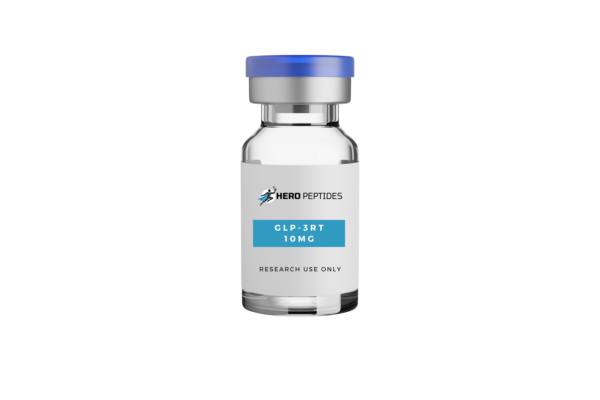
| Hero product | Hero RT |
How to reconstitute retatrutide is a laboratory question with two separate parts. First, establish a compatible preparation from the material documentation and assay requirements. Second, calculate concentration from peptide mass and final solution volume. The second part cannot answer the first.
This guide covers preparation records and concentration math for the catalog’s 5 mg and 10 mg Hero RT vials. The volume tables are hypothetical planning examples, not validated solvent recommendations or instructions for human use.
Origin story: a research compound needs its own preparation record
Retatrutide was developed under the identifier LY3437943. The discovery paper describes a single peptide with activity at GIP, GLP-1, and glucagon receptors. That molecular identity is the starting point for matching a research material to published work (Coskun et al., 2022).
Published development studies do not establish that every supplier lot has the same formulation as the investigational medicine. Keep the supplier material, its analytical documentation, and the cited study preparation distinct. A shared compound name does not make every vehicle interchangeable.
The retatrutide research guide covers the receptor and study background. Here, the focus is what a laboratory record needs before assigning a concentration to a prepared solution.
How retatrutide preparation math works
The formula is concentration = peptide mass ÷ final solution volume. If the mass is in mg and the volume is in mL, concentration is in mg/mL. Multiply mg/mL by 1,000 to express the same concentration in mcg/mL.
Final volume is the denominator. It is not automatically identical to the volume of liquid initially added. Use the preparation method’s defined final volume and record it explicitly rather than hiding that assumption inside the calculation.
Identify the mass basis too. A catalog amount supports nominal math. A suitable quantitative assay may support a measured-content calculation. An HPLC area-purity percentage alone does not establish the amount of peptide in a vial (McCarthy et al., 2023).
Solvent compatibility must be established separately. General peptide-handling guidance states that no single solvent works for every peptide while maintaining every assay’s compatibility. Do not infer a retatrutide-specific solvent or shelf life from a general concentration table (Sigma-Aldrich, accessed 2026).
Key calculations: 5 mg and 10 mg vial tables
The following values assume the stated nominal peptide mass is fully recovered at the stated final volume. They do not establish that a vial can accommodate every listed volume, or that the material is soluble and stable at each concentration.
| Nominal 5 mg vial | Concentration | Equivalent concentration | Mass in a 0.10 mL analytical aliquot |
|---|---|---|---|
| Final volume 1 mL | 5 mg/mL | 5,000 mcg/mL | 500 mcg |
| Final volume 2 mL | 2.5 mg/mL | 2,500 mcg/mL | 250 mcg |
| Final volume 2.5 mL | 2 mg/mL | 2,000 mcg/mL | 200 mcg |
| Nominal 10 mg vial | Concentration | Equivalent concentration | Mass in a 0.10 mL analytical aliquot |
|---|---|---|---|
| Final volume 1 mL | 10 mg/mL | 10,000 mcg/mL | 1,000 mcg |
| Final volume 2 mL | 5 mg/mL | 5,000 mcg/mL | 500 mcg |
| Final volume 2.5 mL | 4 mg/mL | 4,000 mcg/mL | 400 mcg |
The 10 mg vial produces twice the nominal concentration of the 5 mg vial at the same final volume. Conversely, doubling final volume at a fixed mass halves concentration. These relationships provide quick checks before accepting a worksheet result.
They also show why a copied volume is incomplete information. A 0.10 mL analytical aliquot contains 250 mcg in one listed preparation and 1,000 mcg in another. Concentration must remain attached to every volume entry.
For a further working dilution, a 0.10 mL portion of a 5 mg/mL stock contains 0.50 mg. If brought to a final volume of 1 mL with a compatible assay vehicle, its nominal concentration becomes 0.50 mg/mL. That example assumes complete transfer and recovery.
Weak spots: what we don’t know
As of November 5, 2026, retatrutide remains investigational and has not been approved by FDA, according to Lilly’s October 28 announcement. This research preparation guide does not establish equivalence to clinical-trial material (Eli Lilly, 2026).
Neither table establishes dissolution, chemical integrity, microbial quality, or biological activity. Those are separate questions requiring evidence suited to the preparation and intended assay. Correct arithmetic is necessary, but it is not a formulation study.
There is also no universal research-solution expiry supplied by a preservative or a vial size. The shelf-life guide explains why stability evidence must match the compound, vehicle, concentration, container, and storage conditions.
If material remains visible or the solution changes appearance, do not relabel the nominal calculation as a confirmed dissolved concentration. Preserve the observation and seek material-specific guidance before interpreting the preparation’s performance.
Handling retatrutide records in the lab
Record the material identifier, lot, nominal or measured content basis, vehicle, final volume, container, and preparation date. Include the evidence supporting compatibility and storage conditions. Assign the stock a unique identifier that follows its working dilutions.
For the 10 mg-to-2 mL example, record 10 mg ÷ 2 mL = 5 mg/mL, then 5,000 mcg/mL × 0.10 mL = 500 mcg. Reverse the calculation by dividing 500 mcg by 0.10 mL to recover 5,000 mcg/mL.
On a U-100 volume scale, 0.10 mL corresponds to 10 units. The scale does not define retatrutide potency or activity. Keep the explicit volume and stock concentration in the record, and use calibrated laboratory equipment suited to the required precision (FDA, 2024).
Consult the general reconstitution guide and calculator for related checks. A calculator can verify the numbers after the material and preparation assumptions have been established.
Retatrutide reconstitution FAQ
Is 2 mL the required volume for every retatrutide vial?
No. It is one arithmetic example, not a validated universal preparation volume.
Do 5 mg and 10 mg vials give the same concentration?
Only if their final volumes differ accordingly. At the same volume, the 10 mg nominal preparation is twice as concentrated.
Do the tables establish a storage period?
No. Concentration math does not establish solution stability or an expiry date.
What is Hero RT?
Hero RT is Hero Peptides’ retatrutide research material, listed in 5 mg and 10 mg vials. Use its matching documentation to identify the material and evaluate preparation requirements.
References
- Coskun T, et al. LY3437943, a novel triple glucagon, GIP, and GLP-1 receptor agonist for glycemic control and weight loss: From discovery to clinical proof of concept. Cell Metab. 2022;34(9):1234-1247.e9. Source.
- McCarthy D, et al. Reference Standards to Support Quality of Synthetic Peptide Therapeutics. Pharm Res. 2023;40(6):1317-1328. Source.
- Sigma-Aldrich. Peptide Handling Guide. Technical guidance, accessed November 5, 2026. Source.
- Eli Lilly and Company. Lilly’s retatrutide delivered greater A1C reduction and more than double the weight loss of Ozempic’s highest approved dose in head-to-head trial. Company topline announcement, October 28, 2026. Source.
- U.S. Food and Drug Administration. FDA alerts health care providers, compounders and patients of dosing errors associated with compounded injectable semaglutide products. July 26, 2024. Source.
For laboratory research use only. Not for human or veterinary use. This article summarizes published research and is not medical advice.