

Peptide Purity Testing: What HPLC and Mass Spectrometry Measure
Understand how HPLC, mass spectrometry, and content assays answer different questions, with examples that connect analytical reports to laboratory concentration calculations.
| HPLC role | Separation and method-dependent purity assessment |
|---|---|
| Mass-spectrometry role | Mass information supporting identity |
| Content or assay | A separate quantitative measurement |
| Key requirement | Methods suited to the intended question |
| Purity boundary | A percentage alone does not establish vial content or sterility |
| Hero product | BPC-157 |
Peptide purity testing is most useful when the result comes with a clear question. HPLC can separate detectable components. Mass spectrometry can provide evidence about molecular identity. A quantitative assay asks how much peptide is present. These measurements support one another, but they are not interchangeable.
That distinction matters when a report shows an impressive percentage. Before using it in an experiment, determine what the number measures, how the sample was tested, and which quality attributes remain unreported. A large number without a defined basis is difficult to interpret.
Origin story: why peptide testing needs more than one method
Peptide reference-standard work uses several methods because identity, purity, and amount are separate analytical tasks. McCarthy and colleagues describe complementary approaches in characterized peptide standards, including chromatography and mass spectrometry. Their case studies illustrate why one method cannot answer every question (McCarthy et al., 2023).
The practical aim is confidence in the material assigned to an experiment. If the compound is wrong, a precise concentration is unhelpful. If identity is supported but content is unknown, the biological comparison may still begin with an uncertain amount.
Start with the report’s sample and lot identifiers. Analytical detail cannot fix a mismatch between the sample tested and the vial received. The peptide COA guide explains how to check that document trail before interpreting individual results.
How HPLC and mass spectrometry work
HPLC stands for high-performance liquid chromatography. A sample passes through a system designed to separate components. A detector records signals as material emerges, producing peaks over time. The method determines which components separate and which signals are recorded.
For an area-based purity result, the selected peak’s integrated signal is compared with the included peak areas. This describes the detected chromatographic profile under that method. It is not automatically a mass fraction of every substance in the powder.
Mass spectrometry measures mass-to-charge information from ions. For peptides, the reported result may show individual ions or a calculated molecular mass. Ask which quantity appears on the page and how it was compared with the expected material.
Intact mass does not resolve every structural question. McCarthy and colleagues discuss cases where complementary methods are needed for features such as chirality or isobaric amino acids. An expected mass is useful evidence, but its interpretation must fit the method (McCarthy et al., 2023).
Key evidence: three measurements, three questions
| Measurement | Question | Important boundary |
|---|---|---|
| Chromatographic area purity | How is detected signal distributed among included peaks? | Depends on separation, detection, and integration |
| Mass spectrometry | Is mass information consistent with the expected peptide? | Not a universal proof of every structural feature |
| Content or assay | How much peptide is measured or assigned? | Requires a defined quantitative basis |
| Microbiological testing | Does a specified microbial attribute meet its criterion? | Not established by the chemical tests above |
NIST’s archived peptide reference-material report separates UV area purity, peptide mass purity, and molecular-mass information. That is a concrete example of reporting different quantities separately, rather than collapsing them into one purity claim (NIST, 2007).
A hypothetical chromatogram makes the distinction easier to see. If the target peak contributes 990 area units and other included peaks contribute 10, the target represents 99% of the included area. This does not prove that a 10 mg powder sample contains 9.9 mg of target peptide.
Ask what happens if two components overlap or a component is poorly detected. A method must be suitable for its intended purpose. ICH Q2(R2) describes validation characteristics such as specificity, accuracy, precision, and range in the context of analytical procedures (ICH, 2024).
For a report review, keep the method identifier, sample identifier, test date, units, and result together. If supporting chromatograms or spectra are supplied, match them to the report. A screenshot without those connections is harder to evaluate.
Weak spots: what we don’t know
A chemical test panel does not establish every possible contaminant or quality attribute. Water, residual solvents, counterions, endotoxin, and sterility require appropriate evidence. If the report does not include a relevant result, describe that attribute as unreported.
Testing also describes the submitted sample at the tested time. It does not automatically establish later solution stability or every vial’s content. Sampling, lot controls, and storage history remain relevant to the broader conclusion.
As of November 5, 2026, BPC-157 is not an FDA-approved human medicine. In April 2026, FDA moved BPC-157 from its category 2 compounding list to its list of nominations withdrawn by the nominators, though that page still records the agency’s safety concerns. That change is not a drug approval. FDA identifies limited safety information and characterization concerns. A research material’s HPLC or mass-spectrometry result does not change that status (FDA, 2026).
Hero lists Northfield Analytical as its testing partner for lot-level HPLC and mass spectrometry. Request the matching report and read its actual scope. The partnership name is useful for traceability; the report supplies the specific measurements.
Handling peptide test results in the lab
Use a measured content value when one is available and appropriate. If a hypothetical quantitative assay establishes 9.60 mg of peptide recovered at a final volume of 2 mL, the calculated concentration is 4.80 mg/mL, or 4,800 mcg/mL.
A 0.10 mL analytical aliquot would then contain 480 mcg. By contrast, a 10 mg label alone gives a nominal calculation of 5 mg/mL at the same volume. State which basis you used instead of calling both measured concentrations.
Do not apply a 99% area-purity number as an automatic content correction. First establish what the percentage means. The reconstitution guide and calculator check arithmetic, while the test method determines whether its inputs are justified.
Record solvent, final volume, content basis, lot, and preparation date. Keep analytical uncertainty separate from arithmetic rounding. Exact-looking calculations cannot remove uncertainty in the amount originally present.
Peptide purity testing FAQ
Do HPLC and mass spectrometry measure the same thing?
No. They provide different information about a sample and are often used together.
Does 99% area purity establish the amount per vial?
No. A content or assay result needs its own quantitative basis.
Does an expected mass establish sterility?
No. Molecular-mass evidence does not substitute for microbiological testing.
What is Hero BPC-157?
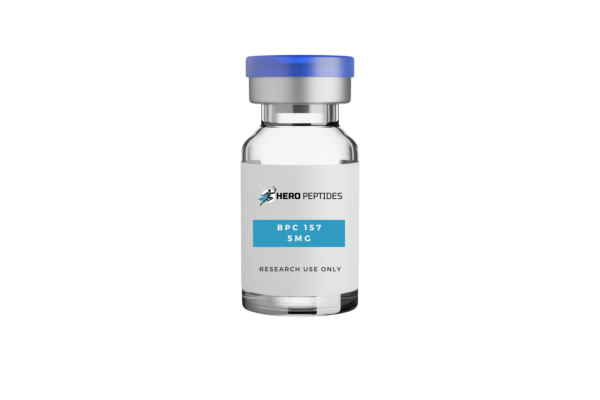
Hero BPC-157 is the catalog’s BPC-157 research material in 5 mg and 10 mg vials. Evaluate its matching lot report against the measurements required by the experiment.
References
- McCarthy D, et al. Reference Standards to Support Quality of Synthetic Peptide Therapeutics. Pharm Res. 2023;40(6):1317-1328. Source.
- National Institute of Standards and Technology. Reference Material 8327: Peptide Reference Material for Molecular Mass and Purity Measurements. Archived report of investigation, March 19, 2007. Source.
- International Council for Harmonisation. Q2(R2): Validation of Analytical Procedures. Final FDA guidance, March 2024. Source.
- U.S. Food and Drug Administration. Certain Bulk Drug Substances for Use in Compounding that May Present Significant Safety Risks. Content current as of April 22, 2026. Accessed November 5, 2026. Source.
For laboratory research use only. Not for human or veterinary use. This article summarizes published research and is not medical advice.