

U-100 Syringe Units Explained: Volume, Mass, and Lab Math
Translate U-100 scale readings into volume, then calculate mass from a known concentration while keeping instrument markings separate from peptide potency.
| U-100 scale relation | 100 scale units correspond to 1 mL |
|---|---|
| One scale unit | 0.01 mL |
| Volume formula | mL = U-100 scale units ÷ 100 |
| Mass formula | Mass = concentration × volume |
| Important distinction | Scale units are not peptide biological-activity units |
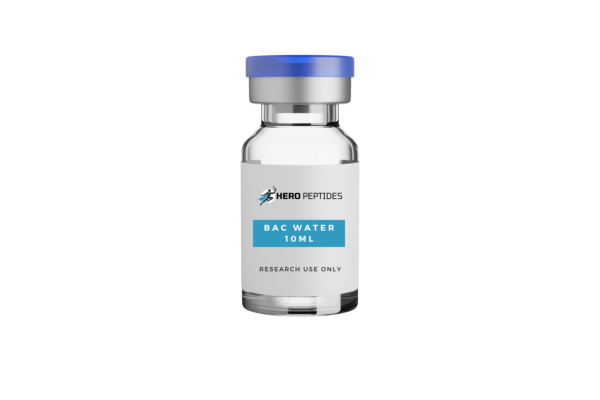
| Hero product | Bacteriostatic Water |
U-100 syringe units are often treated as if they specify an amount of peptide. They do not. A scale reading corresponds to a volume, and the peptide mass in that volume depends on the solution’s concentration. Both pieces of information are needed.
This guide explains the arithmetic for laboratory records. It separates the scale’s original insulin context from calculations involving research solutions, with worked examples in milliliters and micrograms. The same volume can contain very different masses in different stocks.
Origin story: why a volume scale says units
The U-100 convention comes from insulin concentration, where 100 insulin units are present per milliliter. On a matching scale, a 100-unit reading corresponds to 1 mL, and 5 units correspond to 0.05 mL. FDA uses this relationship when explaining conversion errors (FDA, 2024).
When another solution is involved, those markings do not assign it insulin units or peptide activity units. They indicate the corresponding volume. In a laboratory notebook, writing the volume explicitly avoids leaving the meaning of units unresolved.
For example, an entry reading 10 units is incomplete unless the scale is identified. An entry reading 0.10 mL of a 2 mg/mL stock identifies both volume and concentration, so the mass can be calculated without guessing.
How U-100 scale conversions work
The volume formula is simple: volume in mL = scale units ÷ 100. Reversing the conversion gives scale units = mL × 100. These relationships apply specifically to the U-100 scale discussed here, not to every device labeled with units.
Once volume is known, calculate mass using concentration times volume. Keep the units visible. If concentration is in mcg/mL and volume is in mL, the milliliter terms cancel and the answer is in mcg.
For a stock at 2,000 mcg/mL, a volume of 0.05 mL contains 100 mcg. A 0.10 mL volume contains 200 mcg. These are analytical examples, not biological exposure instructions.
Converting mg to mcg is a separate step: 1 mg equals 1,000 mcg. The milli and micro prefixes differ by a factor of 1,000 in the SI system. Changing the mass unit does not change the sample itself (NIST, accessed 2026).
Key evidence and conversion tables
| U-100 scale reading | Volume | Mass at 2,000 mcg/mL |
|---|---|---|
| 1 unit | 0.01 mL | 20 mcg |
| 5 units | 0.05 mL | 100 mcg |
| 10 units | 0.10 mL | 200 mcg |
| 20 units | 0.20 mL | 400 mcg |
| 50 units | 0.50 mL | 1,000 mcg |
The table combines the U-100 volume relationship with an explicitly stated hypothetical concentration. If that concentration changes, the volume column remains the same but the mass column changes. Do not reuse the mass column for a different stock.
Compare two stocks at the same 0.10 mL volume. A 1 mg/mL stock contains 0.10 mg, or 100 mcg, in that volume. A 5 mg/mL stock contains 0.50 mg, or 500 mcg. The scale reading is identical while the mass differs fivefold.
FDA has reported errors involving confusion between units, milliliters, and milligrams in compounded products. The relevance here is the measurement problem: a scale reading without a clear concentration can hide a large calculation error (FDA, 2024).
A good cross-check reverses the calculation. If 200 mcg was calculated for 0.10 mL, dividing 200 mcg by 0.10 mL should recover 2,000 mcg/mL. Reversal often exposes a missing factor of 10 or 1,000.
Weak spots: what we don’t know from the scale
A correct conversion does not establish a device’s measurement uncertainty. Check the actual graduations and intended use. A mathematical value between marks is not proof that the device can measure that value with the accuracy an experiment requires.
The same caution applies to very small volumes. Select calibrated laboratory equipment suited to the required range and the liquid being measured. A convenient scale is not automatically the best tool for quantitative assay preparation.
There is also no universal conversion from these scale units to peptide biological activity. Activity units require a defined assay and standard. They cannot be inferred from the label U-100 or from the peptide’s mass alone.
As of November 5, 2026, this guide explains measurement relationships, not approval or biological suitability of any prepared solution. An accurate volume calculation does not validate the contents, formulation, or intended experiment.
Handling concentration records in the lab
Consider a nominal 10 mg research sample brought to a final volume of 2 mL. Its nominal concentration is 5 mg/mL, or 5,000 mcg/mL. A 0.10 mL analytical aliquot, corresponding to 10 on a U-100 scale, contains a nominal 500 mcg.
Write those three quantities together: concentration, volume, and mass. If only a scale reading is copied into a later worksheet, the information needed to interpret it may be lost. A stock identifier should link the calculation to its preparation record.
If the stock is diluted, update the concentration before using the same volume again. For example, a fivefold dilution of 5 mg/mL produces 1 mg/mL. The same 0.10 mL now contains 100 mcg, not 500 mcg.
See the reconstitution guide, mg-to-mcg guide, and calculator for related checks. The diluent guide covers a separate question, the vehicle’s composition.
U-100 syringe units FAQ
How many milliliters correspond to 10 U-100 scale units?
They correspond to 0.10 mL. The mass in that volume depends on concentration.
Are 10 scale units always the same peptide mass?
No. The volume stays the same, but a different stock concentration changes the mass.
Are these peptide activity units?
No. The scale relationship does not establish a peptide’s biological activity.
What is Hero Bacteriostatic Water?
Hero Bacteriostatic Water is the catalog’s 10 mL laboratory diluent containing 0.9% benzyl alcohol. Its composition does not define a peptide stock’s concentration.
References
- U.S. Food and Drug Administration. FDA alerts health care providers, compounders and patients of dosing errors associated with compounded injectable semaglutide products. July 26, 2024. Source.
- National Institute of Standards and Technology. NIST Guide to the SI, Chapter 4: The Two Classes of SI Units and the SI Prefixes. Accessed November 5, 2026. Source.
For laboratory research use only. Not for human or veterinary use. This article summarizes published research and is not medical advice.