

Copper Peptides in Tissue Research: GHK, Complexes, and Evidence
Separate the GHK peptide from its copper complex, read tissue-model findings in context, and understand why formulation identity matters in laboratory comparisons.
| GHK sequence | Glycine-histidine-lysine |
|---|---|
| GHK-Cu | A copper-associated peptide complex |
| Key distinction | Free peptide, copper salts, and peptide complexes are different materials |
| Evidence example | Rat wound-chamber experiments |
| Measurement boundary | Peptide content and elemental copper are different quantities |
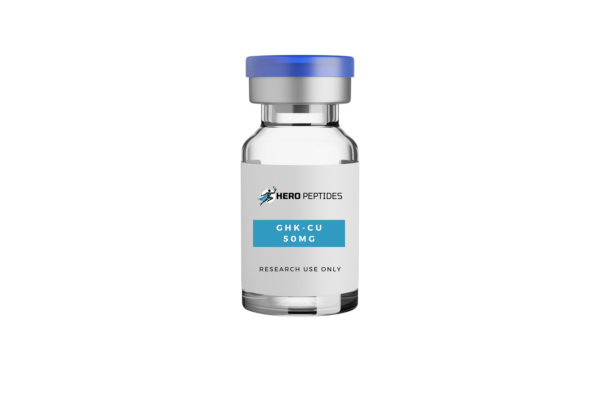
| Hero product | GHK-Cu |
Copper peptides combine two research questions: what the peptide does and what changes when copper is associated with it. GHK-Cu is a familiar example. Its name should not be treated as interchangeable with free GHK, a copper salt, or an undefined mixture.
This distinction matters when interpreting tissue research. A study of a characterized complex in a rat model does not establish every claim made about copper-containing materials. Start with chemical identity, then ask which model and endpoint supplied the evidence.
Origin story: identifying the peptide before the complex
Schlesinger and colleagues identified a growth-modulating serum tripeptide as glycyl-histidyl-lysine. The sequence supplies the letters GHK: glycine, histidine, and lysine. That structural identification is distinct from later questions about its copper-associated forms (Schlesinger et al., 1977).
Maquart and colleagues investigated GHK-Cu in rat experimental wounds using a wound-chamber model. Their work examined connective-tissue-related measurements in that system. It did not test every copper peptide or establish a clinical outcome in people (Maquart et al., 1993).
The GHK-Cu research guide develops the individual compound background. Here, the focus is why complex identity and experimental context matter before comparing tissue-related results.
How copper-peptide identity works
A peptide sequence identifies the connected amino-acid residues. Metal association adds another chemical feature. For GHK-Cu research, the documentation needs to identify the peptide and the copper-containing form rather than supplying only a broad family name.
Keep the peptide ligand, a copper salt, and the intended complex separate in records. They can contribute different components to an assay. A comparison cannot isolate the contribution of the complex if those inputs are left ambiguous.
Also ask how content is reported. Total powder mass, assigned complex mass, peptide content, and elemental copper mass are different quantities. A value in milligrams is not fully interpretable until the measured or declared material is named.
The assay medium belongs in the record too. A material’s identity at procurement does not settle every interaction after dilution into another chemical environment. Interpret biological results using the actual formulation and controls, not the product name alone.
Key evidence: distinguish identity from tissue response
| Research question | Example of evidence | Boundary |
|---|---|---|
| Which peptide sequence is present? | Structural identification of GHK | Does not define every metal-containing form |
| What happens in a tissue model? | Rat wound-chamber measurements with GHK-Cu | Not a human clinical outcome |
| How much material is supplied? | Appropriate content measurement | Units must identify peptide, complex, or another quantity |
| What contributes to an assay response? | Controls appropriate to peptide, metal, and vehicle | A mixture’s response alone cannot assign the contributor |
The rat wound study reported increased connective-tissue accumulation and related matrix measurements under its experimental conditions. The model, complex, and endpoint belong in the same sentence as the finding (Maquart et al., 1993).
Matrix accumulation is not the same endpoint as restored mechanical function or a clinical healing outcome. A tissue marker can be informative while leaving those other questions open. Choose conclusions that match what the experiment actually measured.
For a mechanistic comparison, appropriate controls could distinguish a peptide contribution, a metal contribution, and the complete preparation’s response. The exact design depends on the hypothesis. A result from the complete mixture alone cannot identify every contributor.
Analytical characterization has a similar separation of questions. Peptide reference-standard work distinguishes identity, purity, and assigned amount through complementary methods. A familiar sequence name does not replace a quantitative or form-specific assessment (McCarthy et al., 2023).
Weak spots: what we don’t know
Findings for GHK-Cu should not be generalized to every copper-binding peptide. Different ligands and formulations can create different experimental systems. The broad category copper peptides is too large to support a single outcome claim.
Cell and animal data also do not establish clinical effectiveness or long-term human safety. A report should not replace the phrase rat wound chamber with a general statement about repairing human tissue.
As of November 5, 2026, the Hero research material discussed here is not an FDA-approved injectable human medicine. FDA identifies limited human data and potential immunogenicity concerns for compounded injectable GHK-Cu, which moved from its category 2 list to its withdrawn-nominations list in April 2026. Those comments concern that route and context, not every possible copper-peptide application (FDA, 2026).
Appearance is not a quantitative assay. A colored preparation does not establish the amount or identity of every species present. Use analytical evidence appropriate to the question rather than treating visible color as a complete chemical characterization.
Handling copper-peptide calculations in the lab
Record the declared material, its content basis, lot, vehicle, final volume, and assay medium. Retain the exact form description when moving values from the COA into a worksheet. Do not silently convert complex mass into peptide or elemental copper mass.
For a nominal catalog-mass example, 50 mg of declared GHK-Cu material recovered at a final volume of 5 mL gives 10 mg/mL of that declared material. This is 10,000 mcg/mL, so a 0.10 mL analytical aliquot contains a nominal 1,000 mcg on the same basis.
The example does not establish the original vial’s capacity, solvent compatibility, or elemental copper concentration. If another quantity is needed, use documentation and a method suited to that quantity. Keep the calculation’s basis visible.
The reconstitution guide and calculator help with arithmetic. The COA guide explains why an area-purity result cannot automatically supply all the missing content information.
Copper peptides FAQ
Is GHK the same material as GHK-Cu?
No. The peptide ligand and a copper-associated complex need separate identity descriptions.
Does a rat wound result establish human clinical repair?
No. The model and endpoint limit the conclusion.
Does a complex-mass calculation give elemental copper mass?
No. Those are different quantities and require an appropriate reporting basis.
What is Hero GHK-Cu?
Hero GHK-Cu is the catalog’s GHK-Cu research material, listed in 50 mg and 100 mg vials. Confirm the supplied form and content basis in its matching documentation.
References
- Schlesinger DH, et al. Growth-modulating serum tripeptide is glycyl-histidyl-lysine. Experientia. 1977;33:324-325. Source.
- Maquart FX, et al. In vivo stimulation of connective tissue accumulation by the tripeptide-copper complex glycyl-L-histidyl-L-lysine-Cu2+ in rat experimental wounds. J Clin Invest. 1993;92(5):2368-2376. Source.
- McCarthy D, et al. Reference Standards to Support Quality of Synthetic Peptide Therapeutics. Pharm Res. 2023;40(6):1317-1328. Source.
- U.S. Food and Drug Administration. Certain Bulk Drug Substances for Use in Compounding that May Present Significant Safety Risks. Content current as of April 22, 2026. Accessed November 5, 2026. Source.
For laboratory research use only. Not for human or veterinary use. This article summarizes published research and is not medical advice.