

How to Reconstitute BPC-157: 5 mg and 10 mg Research Vial Math
Work through 5 mg and 10 mg BPC-157 research-vial calculations while distinguishing nominal concentration, measured recovery, compatible vehicles, and supported storage conditions.
| Catalog vial sizes | 5 mg and 10 mg |
|---|---|
| Concentration formula | Mass ÷ final solution volume |
| Nominal calculation | Assumes the stated amount is fully recovered |
| Separate measurement | Actual dissolved or recoverable content |
| Status on November 5, 2026 | Not an FDA-approved human medicine |
| Hero product | BPC-157 |
How to reconstitute BPC-157 is easiest to understand when preparation and calculation stay separate. Material documentation and assay requirements determine the suitable vehicle and handling conditions. Mass divided by final volume determines the nominal concentration.
This guide provides laboratory math for the catalog’s 5 mg and 10 mg BPC-157 vials. It also shows how a measured recovery result changes the calculation. The examples do not establish a universal solvent recipe, vial capacity, or prepared-solution shelf life.
Origin story: a published model is not a universal preparation
BPC-157 is a synthetic 15-amino-acid peptide investigated in experimental models. One frequently cited study examined rat tendon explants and cultured fibroblasts. Its methods and findings belong to those systems, rather than a general instruction for every research vial (Chang et al., 2011).
The BPC-157 research guide covers that biological background. For solution preparation, match the vial to its analytical documentation and define the intended assay. The compound’s name alone does not supply all the needed conditions.
This distinction prevents a common recordkeeping error: borrowing a published concentration while omitting the vehicle, material identity, or measurement basis. A useful laboratory record preserves those details together so another researcher can assess the comparison.
How BPC-157 concentration and recovery work
Calculate concentration using peptide mass ÷ final solution volume. For example, 5 mg at a final volume of 2 mL gives 2.5 mg/mL. The equivalent expression is 2,500 mcg/mL, because 1 mg equals 1,000 mcg.
State whether the mass is nominal or measured. A label amount is a planning input. A separate quantitative method may establish recoverable peptide content. An HPLC area percentage is not automatically a measurement of milligrams per vial (McCarthy et al., 2023).
Use final solution volume, not an unstated assumption about the liquid initially added. The preparation method should define that volume. A clear denominator makes the math reproducible and prevents volume conventions from silently changing between worksheets.
Distinguish a stock from a working dilution. Both need their own concentration entries and preparation identifiers. A working solution does not retain the stock concentration after a further dilution, even though both contain the same named peptide.
Key calculations: 5 mg and 10 mg vial tables
These tables assume complete recovery of the stated nominal mass. Each volume is a hypothetical planning example. Check compatible formulation conditions and container capacity separately before using a preparation method.
| Nominal 5 mg vial | Concentration | Equivalent concentration | Mass in a 0.10 mL analytical aliquot |
|---|---|---|---|
| Final volume 1 mL | 5 mg/mL | 5,000 mcg/mL | 500 mcg |
| Final volume 2 mL | 2.5 mg/mL | 2,500 mcg/mL | 250 mcg |
| Final volume 2.5 mL | 2 mg/mL | 2,000 mcg/mL | 200 mcg |
| Nominal 10 mg vial | Concentration | Equivalent concentration | Mass in a 0.10 mL analytical aliquot |
|---|---|---|---|
| Final volume 1 mL | 10 mg/mL | 10,000 mcg/mL | 1,000 mcg |
| Final volume 2 mL | 5 mg/mL | 5,000 mcg/mL | 500 mcg |
| Final volume 2.5 mL | 4 mg/mL | 4,000 mcg/mL | 400 mcg |
At a fixed volume, doubling nominal mass doubles concentration. At a fixed mass, doubling final volume halves concentration. These relationships are useful checks when reviewing copied entries or calculator output.
Now consider a measured-content example. If a suitable assay establishes 4.80 mg recovered in an unchanged final volume of 2 mL, the recoverable concentration is 2.40 mg/mL. A 0.10 mL analytical aliquot contains 240 mcg, rather than the nominal 250 mcg.
This hypothetical difference does not identify its cause. It could not, by arithmetic alone, distinguish initial content from preparation loss or another analytical issue. Keep the measurement and its interpretation separate until evidence connects them.
Weak spots: what we don’t know
As of November 5, 2026, BPC-157 is not an FDA-approved human medicine. In April 2026, FDA moved BPC-157 from its category 2 compounding list to its list of nominations withdrawn by the nominators, though that page still records the agency’s safety concerns. That change is not a drug approval. FDA identifies limited safety information and concerns involving peptide characterization. A concentration calculation does not resolve those gaps (FDA, 2026).
The tables do not establish complete dissolution, chemical integrity, microbial quality, or assay activity. A preparation can look clear without proving all four. An unexpected appearance can flag a problem without identifying what changed.
The choice between preserved and preservative-free water is also a formulation question. A preservative is another ingredient in the assay mixture. Its presence does not establish a fixed expiry for BPC-157 or sterilize an uncharacterized research powder.
Generic stability claims should stay out of the preparation record unless matching evidence supports them. The reconstituted shelf-life guide explains why the compound, solvent, concentration, container, and conditions all matter.
Handling BPC-157 calculations in the lab
Document the lot, identity evidence, mass basis, vehicle, final volume, container, preparation date, and supported storage conditions. If any later change occurs, preserve it in the history rather than replacing the original entry.
For a working-dilution example, 0.20 mL of a 2.5 mg/mL stock contains 0.50 mg. Bringing that portion to a final volume of 1 mL gives 0.50 mg/mL, or 500 mcg/mL, assuming complete transfer and recovery.
On a U-100 volume scale, 0.10 mL corresponds to 10 units. Those markings do not define BPC-157 potency. Record the explicit volume and concentration, and choose calibrated laboratory equipment appropriate to the volume and precision needed.
The general reconstitution guide and calculator support arithmetic checks. If recovery is uncertain or material remains visible, the dissolution guide helps organize the questions to investigate.
BPC-157 reconstitution FAQ
Is a 5 mg vial always 2.5 mg/mL after preparation?
No. That nominal concentration applies only when the final volume is 2 mL and the assumed amount is fully recovered.
Does a clear solution establish the label amount?
No. Appearance does not substitute for an appropriate quantitative content measurement.
Do the tables establish which diluent to use?
No. Vehicle compatibility must come from material-specific evidence and the assay requirements.
What is Hero BPC-157?
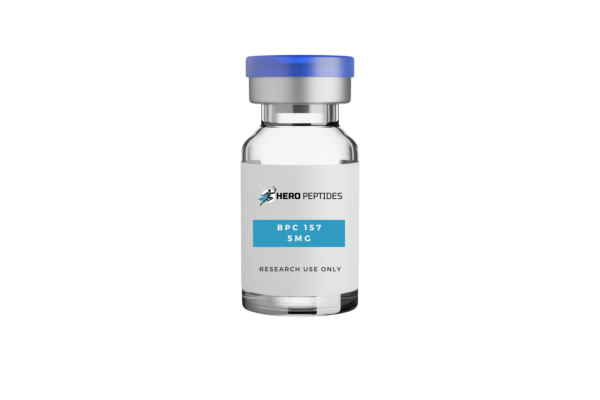
Hero BPC-157 is Hero Peptides’ BPC-157 research material, listed in 5 mg and 10 mg vials. Link each preparation to its matching lot documentation.
References
- Chang CH, et al. The promoting effect of pentadecapeptide BPC 157 on tendon healing involves tendon outgrowth, cell survival, and cell migration. J Appl Physiol. 2011;110(3):774-780. Source.
- McCarthy D, et al. Reference Standards to Support Quality of Synthetic Peptide Therapeutics. Pharm Res. 2023;40(6):1317-1328. Source.
- U.S. Food and Drug Administration. Certain Bulk Drug Substances for Use in Compounding that May Present Significant Safety Risks. Content current as of April 22, 2026. Accessed November 5, 2026. Source.
For laboratory research use only. Not for human or veterinary use. This article summarizes published research and is not medical advice.