

Thymosin Beta 4 Biology: Actin, Migration, and Fragment Research
Explore thymosin beta-4’s actin-related biology while keeping full-length peptide experiments, wound models, and TB-500 fragment identity separate throughout the evidence.
| Full-length material | Thymosin beta-4, a 43-residue peptide |
|---|---|
| Core research theme | Actin-monomer binding and cellular behavior |
| Important distinction | Full-length peptide is different from an isolated fragment |
| TB-500 analytical example | N-acetylated LKKTETQ |
| Evidence boundary | Findings need the exact material and experimental model |
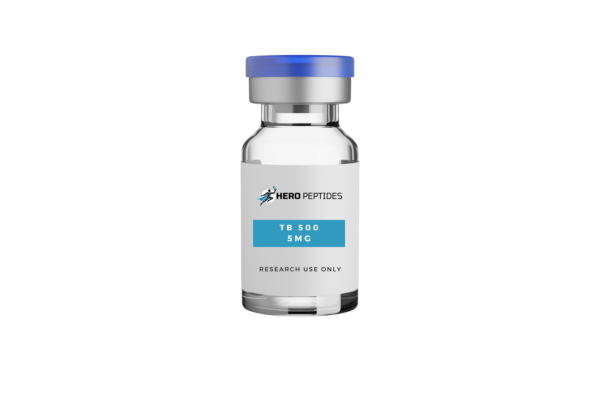
| Hero product | TB-500 |
Thymosin beta 4 research begins with a basic cell component: actin. Cells use actin in structures that change as they move and reorganize. Studying an actin-binding peptide therefore connects molecular interactions with questions about cell behavior.
The evidence also requires a strict identity distinction. Full-length thymosin beta-4 is not the same material as an isolated fragment sold under the name TB-500. This article follows the biology without turning findings from one molecule into claims about another.
Origin story: identifying an actin-binding peptide
Safer and colleagues found that thymosin beta-4 and an actin-sequestering material called Fx were indistinguishable. Their biochemical work connected the peptide with a one-to-one complex involving actin monomers and inhibition of polymerization under the tested conditions (Safer et al., 1991).
That result gave the field a molecular starting point. Actin exists in monomeric and polymerized forms, and binding a monomer can affect its availability. The experiment concerns that interaction rather than a universal instruction to increase tissue growth.
Later wound-related studies asked a broader question about cellular and tissue responses. Those experiments belong beside the biochemical work, but they measure different endpoints. A molecular interaction and a wound-model result should keep their separate labels.
How thymosin beta-4 and its fragments are built
Full-length thymosin beta-4 has 43 amino-acid residues. A short segment preserves only part of that sequence. Its terminal chemistry and modifications can further distinguish it from the same region inside the full-length molecule.
Ho and colleagues characterized TB-500-related material as N-acetylated LKKTETQ in an analytical and equine detection study. That is a defined fragment example, not another name for the complete 43-residue peptide (Ho et al., 2012).
The TB-500 guide covers the catalog-related material. For literature searches, record full-length or fragment, exact sequence where available, and terminal modifications. The broad name thymosin research is not enough to match a material to a paper.
That level of detail also helps when comparing analytical results. An expected mass should match the intended molecule. A full-length standard cannot silently become the identity reference for a chemically distinct fragment.
Key studies: biochemical interaction versus wound-model findings
| Study | Material and system | Finding or scope | Boundary |
|---|---|---|---|
| Safer et al., 1991 | Full-length thymosin beta-4; biochemical actin experiments | Actin-monomer complex and polymerization effects | Not a clinical repair study |
| Malinda et al., 1999 | Full-length thymosin beta-4; rat wounds and cell assays | Wound-related responses and migration | Not an isolated TB-500 fragment experiment |
| Ho et al., 2012 | Acetylated fragment; analytical and equine samples | Identification and detection | Not proof of human efficacy |
Malinda and colleagues reported increased reepithelialization and other wound-related changes in a rat full-thickness wound model. They also examined keratinocyte migration. The model and the full-length material must remain attached to that summary (Malinda et al., 1999).
A migration assay asks about movement under its defined conditions. It does not measure every feature of restored tissue. Likewise, an actin-binding assay does not by itself explain all observed wound responses.
The analytical TB-500 paper answers another question: can the specified material or related products be identified in the tested samples? A successful detection method does not establish a beneficial biological outcome from the detected compound (Ho et al., 2012).
The BPC-157 versus TB-500 comparison uses these distinctions when comparing research areas. Shared words such as migration or repair do not make separate models into a direct efficacy comparison.
Weak spots: what we don’t know
The central gap is transfer of evidence. A finding for full-length thymosin beta-4 cannot automatically establish the same behavior for an isolated fragment. Retaining one sequence region does not prove retention of every function.
Cell and rat-model findings also do not establish clinical effectiveness or long-term human safety. An animal wound endpoint should not be rewritten as a promise about an injury in a person.
As of November 5, 2026, the TB-500 fragment is not an FDA-approved human treatment. In April 2026, FDA moved it from its category 2 compounding list to its list of withdrawn nominations. FDA’s safety information identifies major gaps for thymosin beta-4 fragment LKKTETQ, including a lack of identified human exposure data in the described drug-product context (FDA, 2026).
Even a matching chemical identity does not establish every quality attribute. Content, microbial quality, and solution stability need suitable evidence. A biological explanation cannot substitute for a report on the actual research lot.
Handling thymosin-related materials in the lab
Record the complete identity before assigning concentration. Specify whether the material is full-length thymosin beta-4 or a fragment, and retain its sequence and modification information. Keep that identifier linked to the assay and analytical record.
For catalog-fragment arithmetic, a nominal 10 mg sample recovered at a final volume of 2 mL gives 5 mg/mL, or 5,000 mcg/mL. A 0.10 mL analytical aliquot contains a nominal 500 mcg.
That mass does not establish molar equivalence to full-length thymosin beta-4. Different molecular weights give different molecule counts at equal mass. A molar calculation must use the actual material’s documented molecular weight and content basis.
The reconstitution guide and calculator help check arithmetic. They cannot determine whether a paper tested the same molecule or establish compatibility and stability for an uncharacterized preparation.
Thymosin beta 4 FAQ
Is full-length thymosin beta-4 identical to the TB-500 fragment?
No. They are different materials, so their evidence must be assessed separately.
Does actin binding prove clinical tissue repair?
No. It is a molecular interaction, while clinical outcomes require different evidence.
Does an analytical detection study establish efficacy?
No. It establishes performance of the identification method in the tested context.
What is Hero TB-500?
Hero TB-500 is the catalog’s thymosin beta-4-fragment research material, listed as a 10 mg vial. Confirm its exact identity and modifications in the lot documentation.
References
- Safer D, et al. Thymosin beta 4 and Fx, an actin-sequestering peptide, are indistinguishable. J Biol Chem. 1991;266(7):4029-4032. Source.
- Ho EN, et al. Doping control analysis of TB-500, a synthetic version of an active region of thymosin β4, in equine urine and plasma by liquid chromatography-mass spectrometry. J Chromatogr A. 2012;1265:57-69. Source.
- Malinda KM, et al. Thymosin beta4 accelerates wound healing. J Invest Dermatol. 1999;113(3):364-368. Source.
- U.S. Food and Drug Administration. Certain Bulk Drug Substances for Use in Compounding that May Present Significant Safety Risks. Content current as of April 22, 2026. Accessed November 5, 2026. Source.
For laboratory research use only. Not for human or veterinary use. This article summarizes published research and is not medical advice.